
(5/12/2024)
Link to play — Prototype_3 Metaphors
Introduction
The prompt metaphors is one that I was pretty excited to work on because of my background in films, where a large part of what I was taught was to find metaphors and use them in the right art form.
To take for inspiration, I started by reading a bit of “Making deep games” by Doris Ruschh, and played the games linked in her book. I will say, the MIT GAMBIT Singapore website has some really great and well thought out games, and are a huge inspiration for my pre production process for this game.

Pre-Production
Along with the prompt of making a game based on a metaphor, we were also told that optionally we could make it about folk games, because there is a games festival coming at some point, and a large part of it’s focus is going to be about games.
This seemed like the perfect excuse to make a game based on something that I love talking about, reincarnation, or more specifically, the Hindu philosophies around reincarnation.
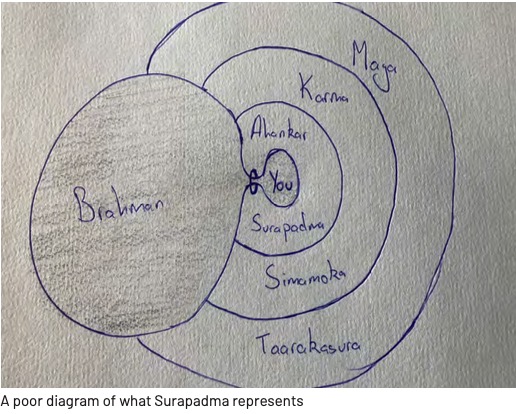
My main inspiration for this, was kurtzgesagt’s ‘The egg’ video(‘(5) The Egg – A Short Story – YouTube’ 2025), which is based on an older video by Andy Weir(The Egg – by Andy Weir 2012), which focuses on a simple philosophy behind reincarnation that is more aligned to the Hindu philosophy, and more importantly, a video from Karuna Sagari’s channel(‘(212) What Does Surapadma and His Brothers Represent? – YouTube’ 2024) where Dr. Sudha Seshayyan talks about what the demon ‘Surapadma’ and his brothers represent in Hindu literature.
When I was in Bangalore, a place I often liked to visit was Hesaraghatta lake. This lake represented alot of things to me and holds alot of personal and cultural significance. There’s a huge tamarind tree at this lake, and a lot of people take shelter underneath it when it’s sunny or they’re tired of walking, and almost like its engraved into the ground, is this little game that the locals like to play called “ChowkaBhara” (Singh 2008).

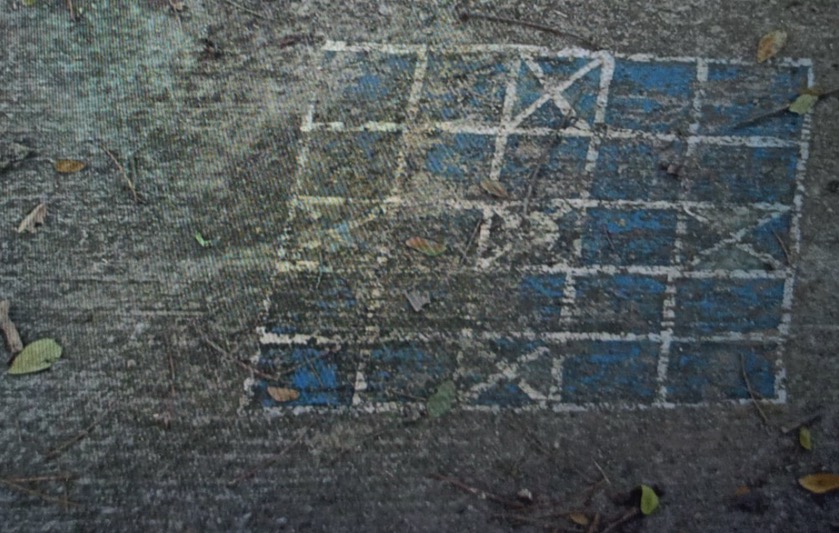
It is also said as a superstition that tamarind trees are connected to the supernatural, and are resting places for ghosts. People say that you should never sleep under a tamarind tree at night.
Until starting my research for this project, I had no idea how this game is played, but I had just seen it being played by locals around the city I lived in. I won’t go into too many of the details but this game is a variation of the game Ludo, where the goal is to get all your pawns to the centre of the board. Culturally its played with shells as the dice, and whatever small fruits you can find around as you as the pawn. The idea is that the closer the fruit gets to the centre, it ‘ripens’.
I knew I wanted to incorporate this game into my project somehow, because it was so culturally prominent that it just made sense. Its almost a visual cue, the visual of a game about getting to the centre, from unripe to ripe, under a tamarind tree by itself represents something metaphorically to anyone who knows anything about Indian culture.
since it was about reincarnation, it was also fairly obvious to me that the game loop had to be about reincarnation. Reincarnation was the loop. And the idea was that on every loop, the player had to realise something about the reality they are living in, or the visual reality (the game) that they are playing in.
To tie everything together, there had to be a ‘life’ sequence, a ‘death’ sequence, and a reincarnation mini-game. So the player would learn something about the game in every life(The three questions, about reality, about karma and about ego), talk to this mysterious death figure, which philosophically resembled Brahman, and the untold end goal of the game, was to end the game by getting close to Brahman and end the process of reincarnation.
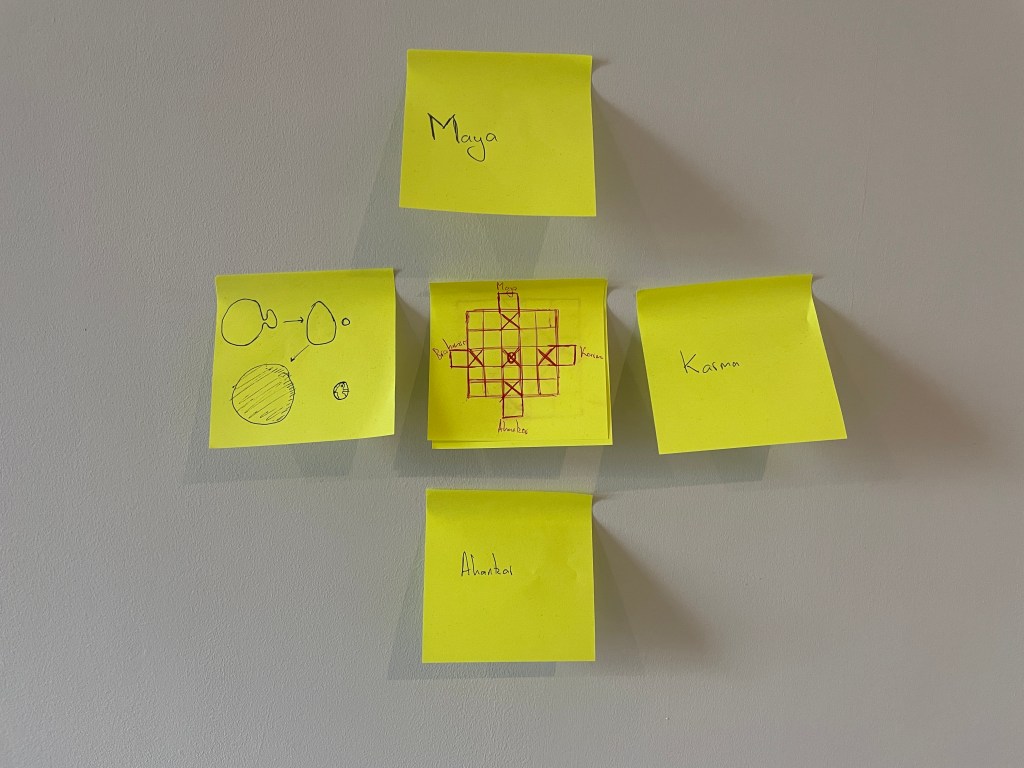
I also knew I could play with the dimensionality and level of control over the sequences because of the nature of Unity engine, so I wanted the death part to have the least amount of control, but with the highest amount of dimensionality(3D), and the life part to have a gradually increasing level of control and choice, but with the least amount of dimensionality (2D). The idea is to add an extra dimension to this mysterious figure at the end of your life, because it couldn’t just be perceived in your two-dimensional life.


To increase the effect of dimensionality, I made use of gyroscopic functionality in the level design. And to make the player feel more mortal during the ‘life’ sequence, I made use of a ticking sound effect.
Production
I decided on using Unity and making this a mobile game, because this more closely aligns with my long term goals of making great mobile games that have an impact.
There was alot to learn in my production process for this project, but here is a list of all the things I had to learn:
- making buttons and touch screen work with the new input system
- basic understanding of animations in unity
- URP shader graphs
- importing Maya models
- gyroscope functionality
- making cutscenes in Unity
- basic understanding of Coroutines in Unity
- dialogue systems with Ink and Unity
- Basic understanding of particle systems in unity
- Exporting to Xcode and iOS
Overall, it was an extremely steep learning curve, and this ended up helping me in my Christmas vacation, because I could go back and optimise all my other projects, writing cleaner code and making everything work better, all while just generally being much more efficient and quick compared to when I had started. It was also a huge confidence boost, because I know I can do alot more than what I used to be able to do now.
After the first play testing I made the following changes to my game:
- Added a ‘reset gyroscope’ functionality
- Added physics materials to reincarnation level
- Made the level design slight easier for reincarnation level
- removed external art assets from life stage, drew the assets myself instead.
- Added one more loop
- Made a better working dialogue system
- Improved writing for the death stage
Conclusion
At this stage, it still feels like my game is still bit incomplete, but as long as it gets the feel of the game across, its a successful, complete prototype. I could keep spending more time but I’m a bit tired of working on this, and I want to come back to this game with a fresh mind and more ideas and complete it properly before the Now Play This festival. I’m still a bit unhappy with how it is to play from a game mechanics standpoint, there’s not clear way to win or lose, and there’s no competitive nature to the game yet, but from the perspective of wanting to make a deep game, its a win.
Bibliography
‘(5) The Egg – A Short Story – YouTube’. 2025. [online]. Available at: https://www.youtube.com/watch?v=h6fcK_fRYaI&t=35s [accessed 7 Jan 2025].
‘(212) What Does Surapadma and His Brothers Represent? – YouTube’. 2024. [online]. Available at: https://www.youtube.com/ [accessed 7 Dec 2024].
SINGH, Rg. 2008. ‘Traditional Board Games of India: Chauka Bara’. Traditional Board Games of India [online]. Available at: http://kreedaakaushalya.blogspot.com/2008/05/chauka-bara.html [accessed 14 Dec 2024].
The Egg – by Andy Weir [Film]. 2012. Available at: https://www.youtube.com/watch?v=D1VN5zICGeU [accessed 7 Jan 2025].
 Avi
Avi 
Leave a comment