
Research on Surrealist Games
Having analysed surrealist games a bit more, through “a book of surrealist games”, I noticed a common loop across surrealist games that demand creativity from the player.

The game loop usually consists of three parts:
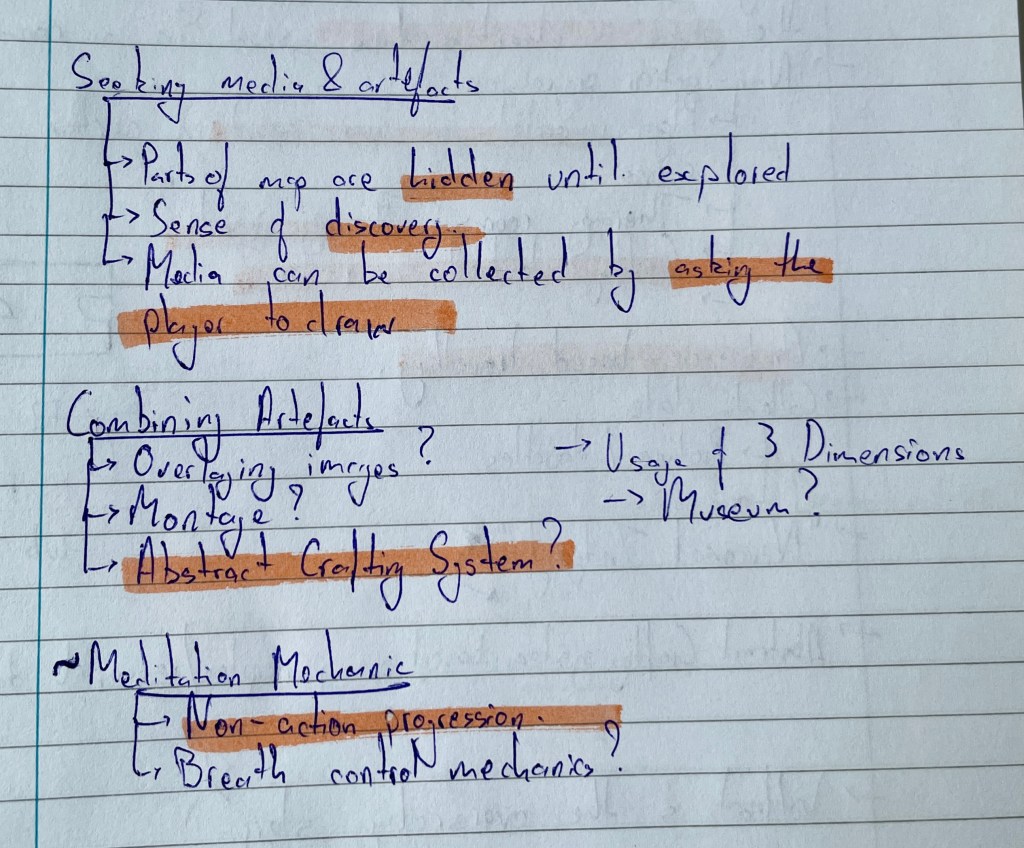
- Collecting Media/ Artefacts
- Combining Media/ Artefacts
- Making sense of the final outcome
I started listing down all the different mechanics that came to my mind when I thought about these activities. How would I collect media? How would you combine them?
I was also thinking about how I can integrate a meditation mechanic to the game. Maybe a non-action progression system?
GDC Talks
I saw two GDC talks for my research as well, one on manifold garden(‘Manifold Garden: Level Design in Impossible Geometry – YouTube’ 2025), and one one designing a ‘Trance'(‘(118) Designing a Trance: Meditation and Game Design – YouTube’ 2025).
The vision for manifold garden(‘Manifold Garden on Steam’ 2025), developed by William Chyr, helped me think about the mathematical creativity games could possess, along with architectural tropes such as indian step wells, something I’m planning to include in a prototype version of my game now.
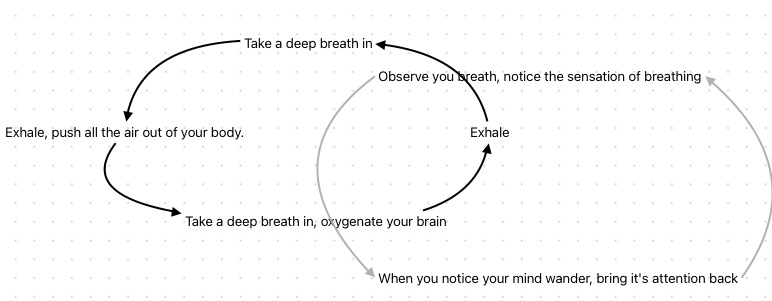
Dennis Weir’s talk on designing a trance informed me a lot about about the design practices that could go into play while making a meditative game. He opened the talk with outlining the loop of meditation, which I found so incredibly helpful. Its as simple as it gets, and tying it in with the previous blog, it helps create a loop that can also facilitate in removing the training wheels of meditation.
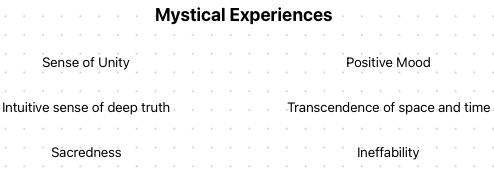
He listed down some ‘Mystical Experiences’ as well, which serve as good abstract goals for a design of a game.
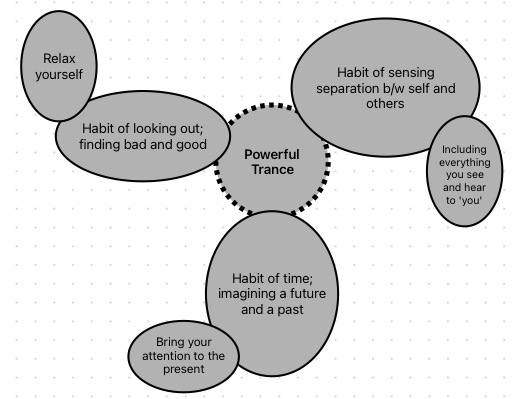
And perhaps most importantly, understanding how all games are a trance, and in order to enter a trance, we need a network of mutually reinforcing self-perpetuating mental loops helped me a lot, along with an outline of said loop.
Some Initial Play Testing Feedback
Upon giving a very early build to a friend for play testing, I learnt a couple things,
- He seemed to be really interested in the step well architecture, often spending alot of time around it and interacting with it.
- There was a bug in the game where if you entered the step well architecture, you could jump extremely high. Although this was a bug, he actually liked it and almost thought of it as a feature, so the player could have a kind of ‘bird’s eye view’ of the world/gallery they were building.
Game and Ontology
- Using all the research, I made a really simple design for a game, which expanded naturally by itself.
- I thought about how the player needed to have a sense of time passing, but different to how it exists in other games. Because of this, the player should not be able to die in the game.
- One way to reinforce the abstract ideas or mystical experiences, or to just give a feel of this, is to make the player feel like a god. Because of this, the player needs to feel like they’re playing a god simulator.
- Being a god of everything is great, but the emotions that come attached with such a position is not appropriate for a meditation game used to study the self. Because of this, it is better to think of it as a “god of yourself” rather than just “a god” or a “god of everything”. Thinking of being a “god of yourself” is something that Dennis Weir also mentioned in his talk.
- Non-action progression is a great way to achieve the meditative goals of the game.
- Thinking of a ‘hub and spoke system’, like Zelda, something I learnt from the advanced game design book(Adams 2012).
- The hub can be used as a gallery to showcase art, and the various rooms connected can be used as abstract crafting systems to process the collected media/ artefacts.
- The architecture could resemble a temple, asking the user to “create a temple of you”
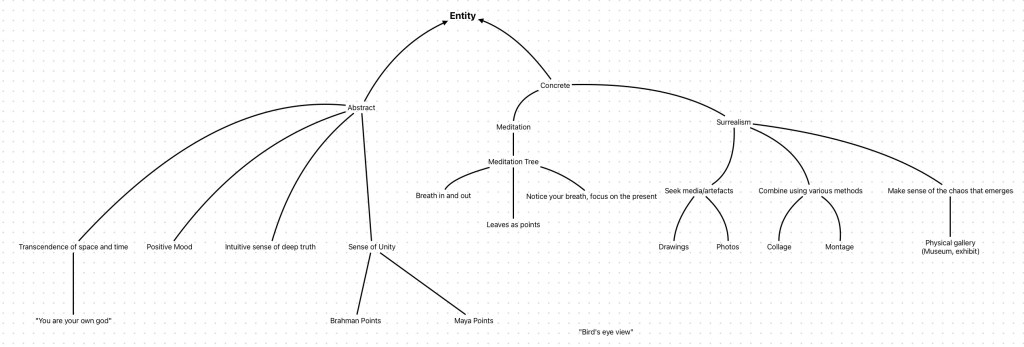
BRIEF DESCRIPTION
You are a god, you are your creator. You have brought yourself into existence through a combination of reality and illusion. Using reality and illusion points, you work on understanding yourself through contemplative practice, and making art, building a gallery of all the different work personal to you.
Bibliography
‘(118) Designing a Trance: Meditation and Game Design – YouTube’. 2025. [online]. Available at: https://www.youtube.com/watch?v=zZ8BFsdbem0 [accessed 17 Feb 2025].
ADAMS, Ernest. 2012. ‘Game Mechanics: Advanced Game Design’ [online]. Available at: https://www.academia.edu/81246717/Game_Mechanics_Advanced_Game_Design [accessed 21 Feb 2025].
ATHRAY, Bharti. 2019. ‘Why Are the Popular Hindu Temples a Scene of Chaos?’ Bhartithewriter [online]. Available at: https://bhartithewriter.wordpress.com/2019/01/12/why-are-the-popular-hindu-temples-a-scene-of-chaos/ [accessed 18 Feb 2025].
HUT, Fonts. 2022. ‘Obvia Font’. Fonts Hut [online]. Available at: https://www.fontshut.com/obvia-font/ [accessed 16 Feb 2025].
K. R. SRINIVASAN. 1971. Temples Of South India. Available at: http://archive.org/details/Acc.No.24635TemplesOfSouthIndia1971 [accessed 18 Feb 2025].
LIVINGSTON, Morna. 2002. Steps to Water : The Ancient Stepwells of India. New York : Princeton Architectural Press. Available at: http://archive.org/details/stepstowateranci0000livi [accessed 19 Feb 2025].
‘Manifold Garden: Level Design in Impossible Geometry – YouTube’. 2025. [online]. Available at: https://www.youtube.com/ [accessed 21 Feb 2025].
 Avi
Avi 
Leave a comment