
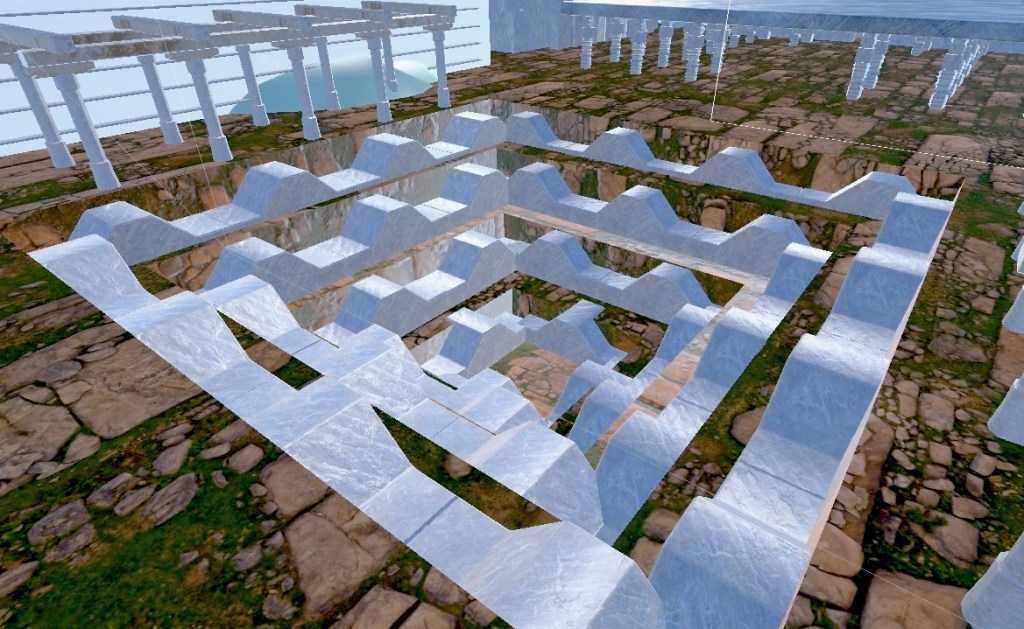
link to game — https://aviparmar.itch.io/samkhya-illusion-reality-experimental-game
Brief Description
You are a god. Through mind, matter and spirit, you create a temple of your work.
The objective of the game is to keep reality and illusion balanced. Meditation increases reality, creating art increases illusion.
Gameplay Video
One-Page Game Design Document
Research
Initial Ideation Process
I had a list of about 30 ideas, roughly written down as vague words or sentences to draw tangents from.


I eventually ended up filtering this down to about 3 ideas:
- A ‘Doom-Scrolling’ mechanic for a game
2. Integrating machine learning and AI
3. A mindfulness/meditation surrealist game
I finally chose making a mindfulness/meditation app, that uses surreal game mechanics to train the subconscious mind to be more creative, influenced by Dali’s bell and Jesse Schell’s subconscious and brainstorming tips (Schell 2008).
I was also driven by my personal experience with creative burnouts, and general difficulties being creative sometimes. And since the game deals with such topics I was hoping it would help the user to understand themselves as well.
Research
I took printouts of three research papers and have read one of them completely so far. The paper (Lukoff et al. 2020) talks about what buddhists, yogis and therapeutic teachers think about meditation apps, and also contains a lot of references to Dahl and Davidson’s contemplative practices.
They go on to highlight some problems, the ones that stood out for me are
- “McMindfulness” — the marketing of contemplative practice as a quick harmless exercise for relief
- Apps generally seem to focus on mindfulness and relaxation, when meditation could be used for invoking kindness and compassion.
- Relaxation can yield mindfulness through container and correlation pathways, mindfulness can yield to deconstructive or constructive experiences in the brain.
This research paper also served as a good reference for some design guidelines:
- Designing for less dependence — the designer could omit soothing visuals and sounds.
- Gradually reducing scaffolding — technologies should gradually shift students to lesser reliance on extrinsic processes.
- Transfer mindfulness — from formal to informal practice to everyday life.
Another resource of research was the book of Surrealist Games (Alastair Brotchie 1995). I tried to note down any and all games from the book that sounded interesting. I loved the surrealist nature of these games, the ‘Dali’s bell’ feeling that all these games give out. But generally speaking it was a bit difficult for me to think about ways to implement these digitally, while integrating meditation.
As mentioned previously, a large part of the inspiration was also Jesse Schell’s book, and I found a quote that he had referenced in the book that really helped me articulate my own thoughts on what the game is supposed to be –
“Should we be mindful of dreams?” Joseph asked. “Can we interpret them?”
The Master looked into his eyes and said tersely: “We should be mindful of everything, for we can interpret everything.” – Herman Hesse, The Glass Bead Game (Schell 2008)
Prototype Development
- Inspired by the ‘fumage’ technique in the book of surrealist games(Alastair Brotchie 1995), I wanted to create a prototype that used the technique of fumage to create a heightmap for a procedurally generated terrain.
- I wanted to make a kind of emotional prototype to test if this is something I would get excited about, and to see if I can execute it. The idea is that if I can get a prototype to work in under 3 days, it would be simple enough to take forward with me for the rest of the project.
- In the beginning, I didn’t know what exactly about this prototype would be exciting. Would it work as a mini game among many other mini games? Or would I want to use it as a platform to build on top of?
Play Testing Feedback
Now after having a prototype and testing it, I’ve felt that it is fairly exciting, and a nice procedural mechanic to build on top of to encourage the user to meditate and create a world.
Upon showing it off to friends however, the general consensus seems to be initial polite excitement followed by “now what”. And Jeff made a really good point, which is that if I go forward with this route, theres a good chance my game could end up being a bunch of mini-games, rather than one coherent game.
Research on Surrealist Games
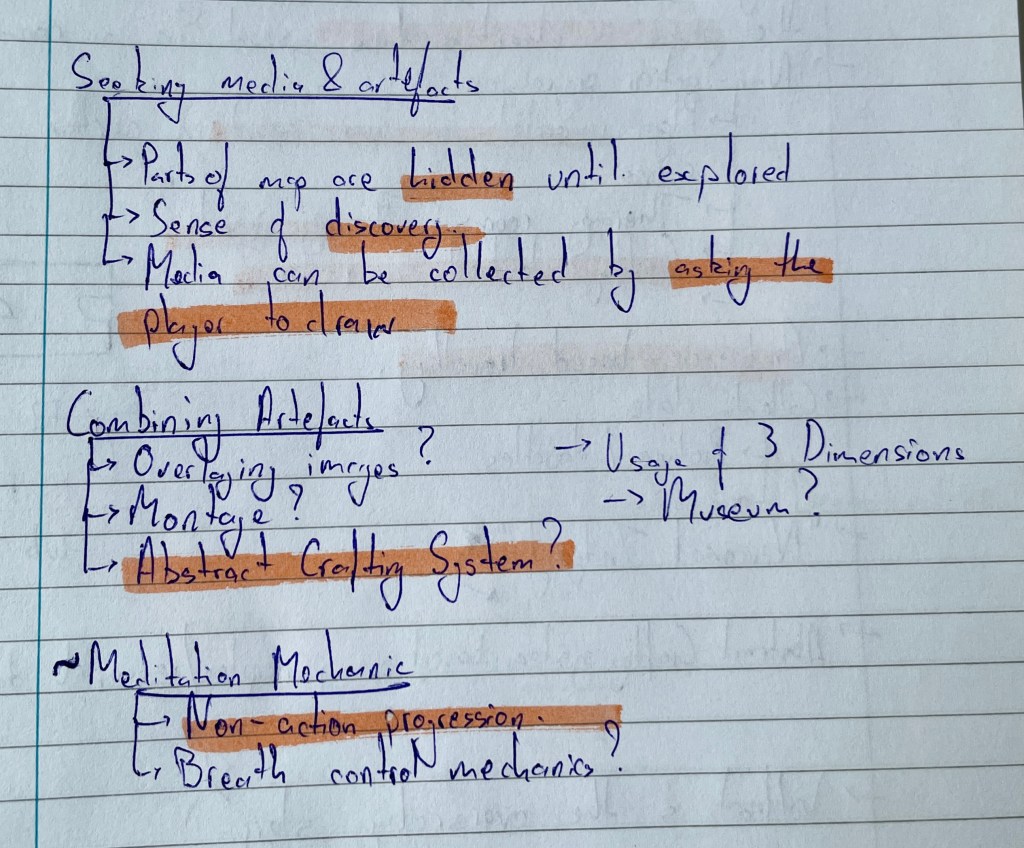
Having analysed surrealist games a bit more, through “a book of surrealist games”, I noticed a common loop across surrealist games that demand creativity from the player.

The game loop usually consists of three parts:
- Collecting Media/ Artefacts
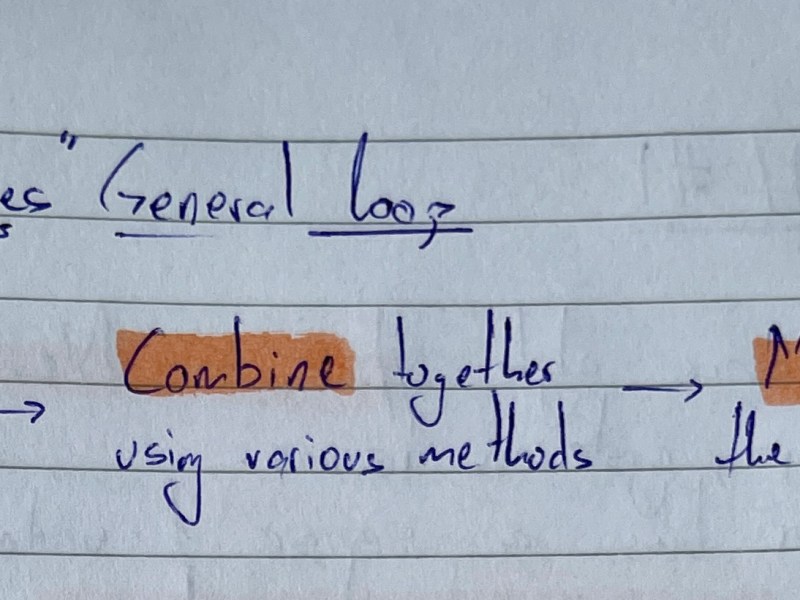
- Combining Media/ Artefacts
- Making sense of the final outcome
I started listing down all the different mechanics that came to my mind when I thought about these activities. How would I collect media? How would you combine them?
I was also thinking about how I can integrate a meditation mechanic to the game. Maybe a non-action progression system?
GDC Talks
I saw two GDC talks for my research as well, one on manifold garden(‘Manifold Garden: Level Design in Impossible Geometry – YouTube’ 2025), and one one designing a ‘Trance'(‘(118) Designing a Trance: Meditation and Game Design – YouTube’ 2025).
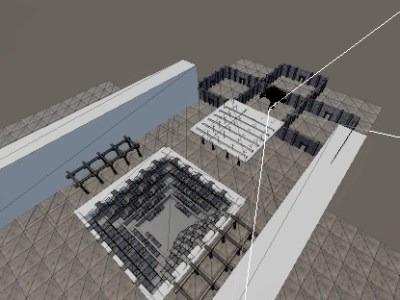
The vision for manifold garden(‘Manifold Garden on Steam’ 2025), developed by William Chyr, helped me think about the mathematical creativity games could possess, along with architectural tropes such as indian step wells, something I’m planning to include in a prototype version of my game now.
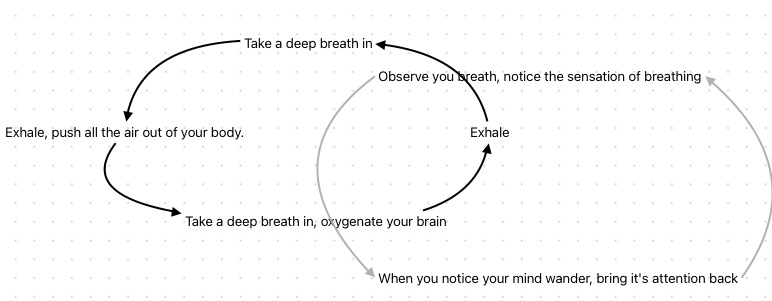
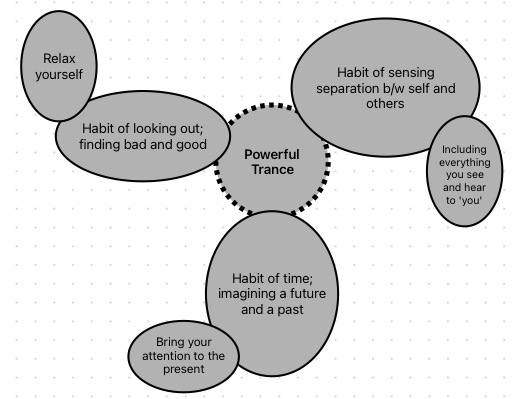
Dennis Weir’s talk on designing a trance informed me a lot about about the design practices that could go into play while making a meditative game. He opened the talk with outlining the loop of meditation, which I found so incredibly helpful. Its as simple as it gets, and tying it in with the previous blog, it helps create a loop that can also facilitate in removing the training wheels of meditation.
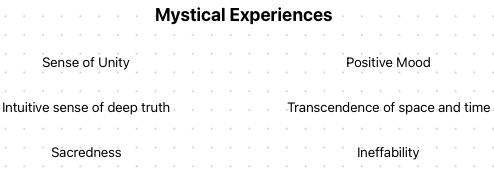
He listed down some ‘Mystical Experiences’ as well, which serve as good abstract goals for a design of a game.
And perhaps most importantly, understanding how all games are a trance, and in order to enter a trance, we need a network of mutually reinforcing self-perpetuating mental loops helped me a lot, along with an outline of said loop.
Some Initial Play Testing Feedback
Upon giving a very early build to a friend for play testing, I learnt a couple things,
- He seemed to be really interested in the step well architecture, often spending alot of time around it and interacting with it.
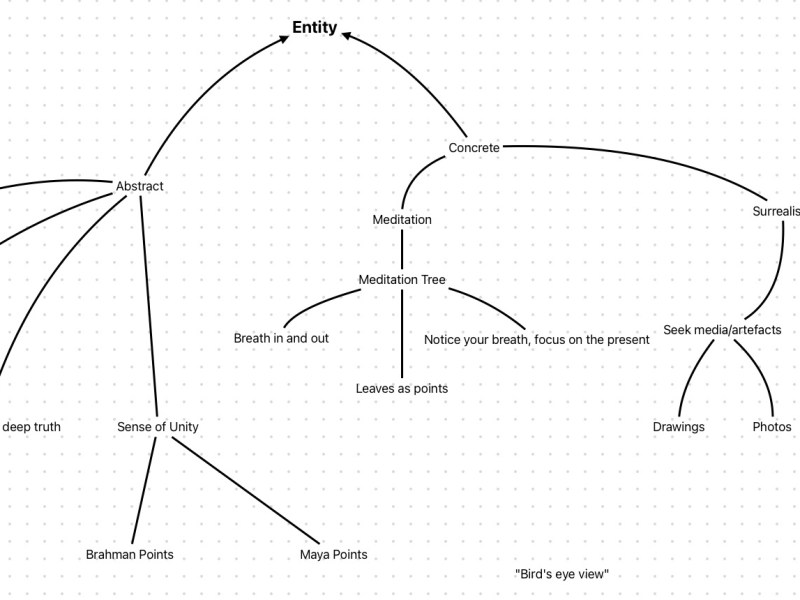
- There was a bug in the game where if you entered the step well architecture, you could jump extremely high. Although this was a bug, he actually liked it and almost thought of it as a feature, so the player could have a kind of ‘bird’s eye view’ of the world/gallery they were building.
Game and Ontology
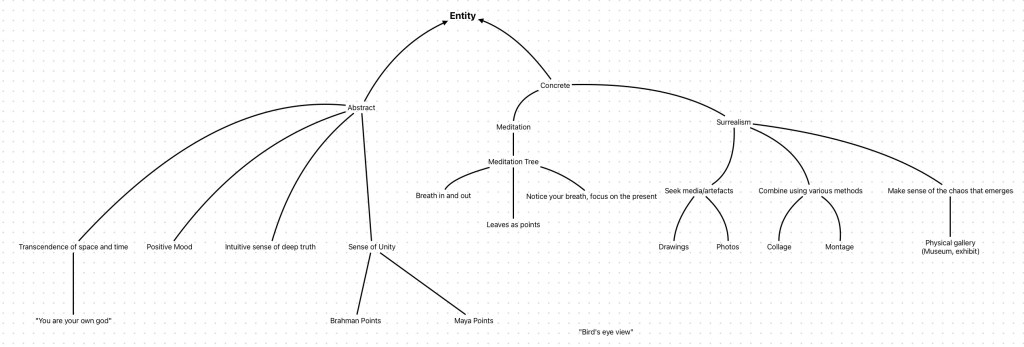
- Using all the research, I made a really simple design for a game, which expanded naturally by itself.
- I thought about how the player needed to have a sense of time passing, but different to how it exists in other games. Because of this, the player should not be able to die in the game.
- One way to reinforce the abstract ideas or mystical experiences, or to just give a feel of this, is to make the player feel like a god. Because of this, the player needs to feel like they’re playing a god simulator.
- Being a god of everything is great, but the emotions that come attached with such a position is not appropriate for a meditation game used to study the self. Because of this, it is better to think of it as a “god of yourself” rather than just “a god” or a “god of everything”. Thinking of being a “god of yourself” is something that Dennis Weir also mentioned in his talk.
- Non-action progression is a great way to achieve the meditative goals of the game.
- Thinking of a ‘hub and spoke system’, like Zelda, something I learnt from the advanced game design book(Adams 2012).
- The hub can be used as a gallery to showcase art, and the various rooms connected can be used as abstract crafting systems to process the collected media/ artefacts.
- The architecture could resemble a temple, asking the user to “create a temple of you”
BRIEF DESCRIPTION
You are a god, you are your creator. You have brought yourself into existence through a combination of reality and illusion. Using reality and illusion points, you work on understanding yourself through contemplative practice, and making art, building a gallery of all the different work personal to you.
Development Journals
Illusion and Reality | Week 1 Development Blog
Initial Ideation Process I had a list of about 30 ideas, roughly written down as vague words or sentences to draw tangents from. I eventually ended up filtering this down to about 3 ideas: 2. Integrating machine learning and AI 3. A mindfulness/meditation surrealist game I finally chose making a mindfulness/meditation app, that uses surreal game…

Illusion and Reality | Week 2 Development Blog
Research on Surrealist Games Having analysed surrealist games a bit more, through “a book of surrealist games”, I noticed a common loop across surrealist games that demand creativity from the player. The game loop usually consists of three parts: I started listing down all the different mechanics that came to my mind when I thought…
Illusion and Reality | Week 3 Development Blog
Further Research Unity Development Game Art Further development Bibliography ADAMS, Ernest and Joris DORMANS. 2012. Game Mechanics: Advanced Game Design. New Riders. EASWARAN, Eknath. 2010a. ‘Ch6. The Practice of Meditation’. In The Bhagvad Gita. 133. EASWARAN, Eknath. 2010b. ‘Ch7. Wisdom from Realization’. In The Bhagvad Gita. 147. EASWARAN, Eknath. 2010c. The Bhagvad Gita. HARDY, Adam. n.d. ‘The Temple Architecture…
Illusion and Reality | Week 4 & 5 Development Blog
Animal Crossing I bought Animal Crossing New Horizons(‘Animal CrossingTM: New Horizons for the Nintendo SwitchTM System – Official Site’ 2025) for my switch in hopes that it would help me with the research of my game. I learnt that some of the mechanics in the game could really help me with the development of my…
 Avi
Avi 
Leave a comment