
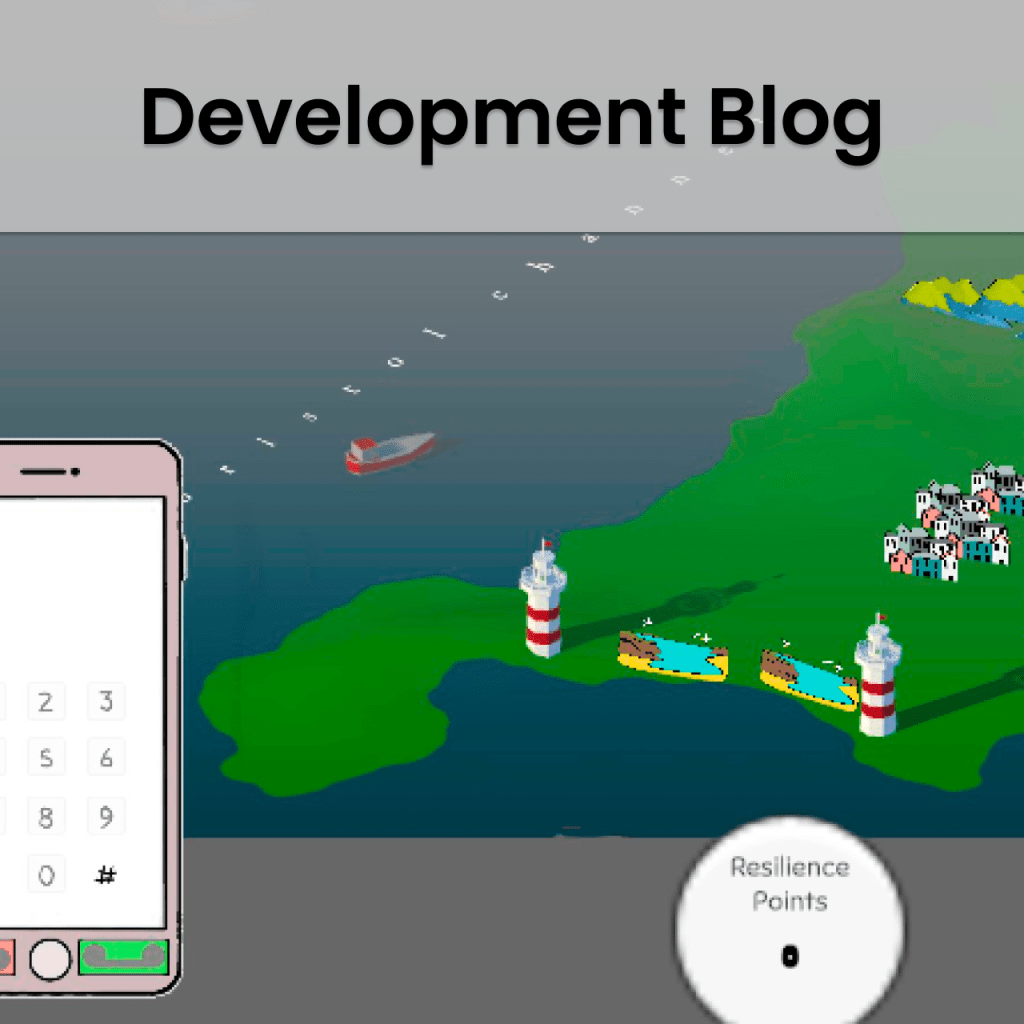
link to play — https://gourav-ranganath.itch.io/gallos-kernow
Brief
‘Gallos Kernow’ is a project made by Masters students at Falmouth University, for the Devon, Cornwall and Isles of Scilly Local Resilience Forum (LRF).
The aim of the project is to develop a computer-based game, targeted at primary school aged young people, to support the development of their awareness and resilience towards a range of challenges and situations that they may face within the areas they live.
Introduction
The briefs
Since this is both, a university project and a client project, we were given two briefs, one from the university, and one from the client.
Falmouth University’s brief — The brief mainly graded us on 3 learning outcomes – our abilities to collaborate, to deliver something innovative, and the ability to communicate and present our ideas.
The Client Brief — The council and the LRF wanted us to make a game to support the preparedness, response, and recovery of people and communities to incidents and emergency situations. This might include weather and climate incidents, civil emergencies, medical incidents and loss of utility. While ‘resilience’ could mean a lot of things, the focus of this project was on aspects of knowledge, awareness and behaviour which supports personal safety and wellbeing.
There were also other requirements, like the content of the game needed to be appropriate for primary school aged children, and LRF was a partnership with multiple public sector bodies such as blue light and health workers, which set up some context for the rest of the project.
As a group of 8, we were given the task of following both the briefs, to achieve learning outcomes from the University, and to meet the client’s expectations.
Group Members
We had a total of 8 group members including me. The team consisted of 1 artist, 2 programmers, and 5 designers. I was on the design team. We also had a facilitator who helped guide us through the project, and was often our bridge of communication with the client.
My contributions
To summarise my contributions, I designed various game systems, wrote user stories, created art assets and made UI assets for the game.
Through the process, we had multiple peer review feedback sessions, where all of us, including the facilitator had to grade us for our collaborative skills and our output through the project. I earned multiple distinction level feedbacks from both, peers and faculty.
Ideation
Initial research
My primary research points for the making of this game was mostly from reading play=learning (G. Singer et al. 2006) and Imagination and play in the electronic age (G. Singer and L. Singer 2005).
These are some of the main points I found to be useful during my research, and were communicated to the rest of my team as well:
- Children who have been traumatised can use pretend play with their mothers to work through their stress
- Children who play together learn to work together
- Children suffer from a ‘nature-deficit disorder’
- Parents rank “releasing energy” as the #1 benefit of play
- Children who have autism have a limited ability to engage with symbolic play
- Pretend play can build self-regulation, which is central to our conception of what it means to be human
- Learning occurs best when there is meaningful context, children are given choices, and are encouraged to follow their own interests.

Besides this, I also did some basic research on Cornwall from whatever I could find in the Falmouth library and the internet. Some of the things that really stuck with me are Cornish Choughs, standing stones, and lighthouses around Cornwall
Splitting the team
Since this is a client project, and none of us knew what the client’s expectations were, I had proposed the idea of splitting the group into 4, with each team having 2 team members.
The idea was to pitch multiple different ideas, and see which ones resonate with our client more, so we have a better understanding of what kind of game the client is expecting.
Initially, my group members opposed splitting the newly formed team, but after receiving similar feedback from our course leader, and understanding that the selected team is chosen based on the client’s expectations, we proceeded with this strategy.
The 4 different ideas
Team 1 — A detective game with time travel elements.
Team 2 (which I was a part of) — RTS style game with a phone dialling mechanic.
Team 3 — Expanding and defending an island against common natural disasters
Team 4 — A lighthouse game resembling mechanics from ‘5 nights at Freddies’
Unfortunately, team 4 wasn’t able to present on that day, but the client had seen the first 3 pitches, and liked something about each of them.
My Idea
link to play — https://aviparmar.itch.io/gallos-kernow-prototype-1
Team 2, Me and Gourav Ranganath, wanted to take an RTS approach to the game. Our philosophy was that whenever we thought of expressing resilience through game mechanics, we kept coming back to the systems and resources of an RTS style game. RTS also has a unique way of tying in all the different elements from our client’s brief together.
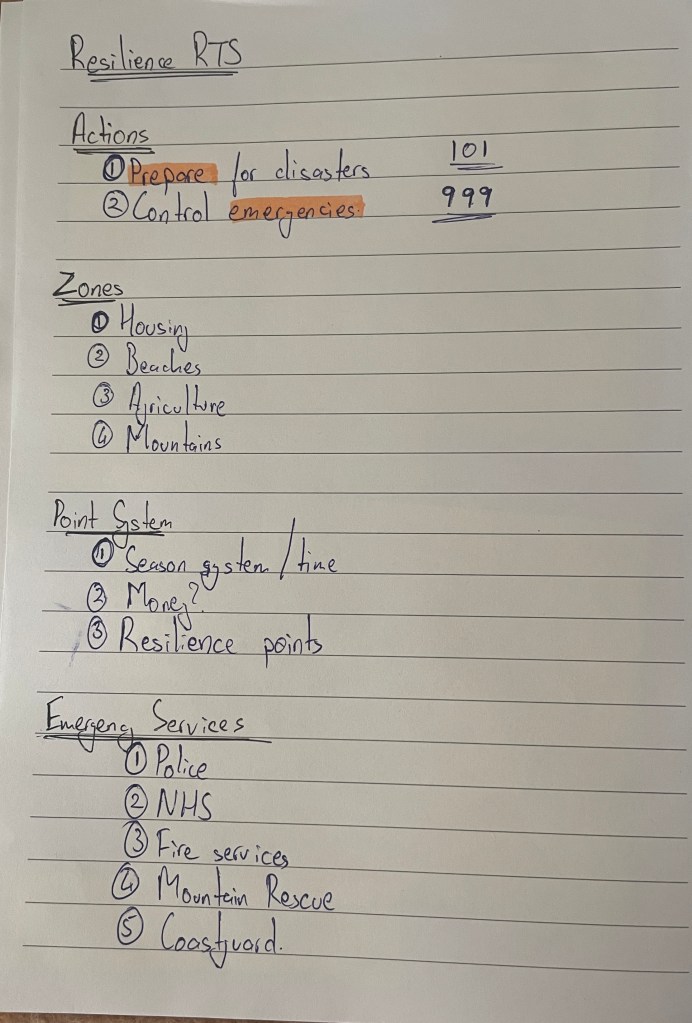
We started with listing down all the elements, verbs, actions and other things that our RTS game could have. This eventually meant 4 different groups : Actions, Zones, Point System and Emergency Services.
After connecting everything together, we finally had a playable prototype and a one page GDD.
Client Feedback
The client liked that the narrative game felt personal, the RTS game’s map had the potential to teach children about various Cornish landmarks, and the resource management game had the potential to make children more aware about how one can defend against disasters.
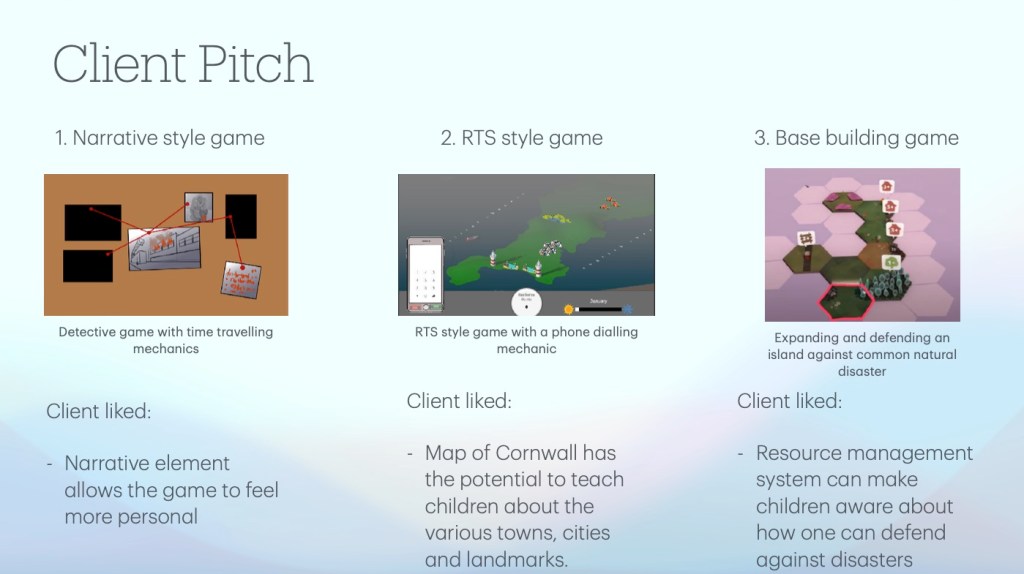
The client had also pitched us some more requirements:
- They wanted a Cornwall map game where the player can zoom in and out of various landmarks around Cornwall
- They wanted the events in the RTS style games to connect to narrative or quiz like mini games.
- Children in Cornwall can often have a hard time reading , so a narration would be required, while keeping in mind the potential of teaching a child to read more
- The game must be simple for younger children
- The game must be interesting for children entering their teens
Idea V1
I would highly encourage to watch the play testing video before you read ahead, since a lot more things would make sense once the gameplay from the first prototyping phase is understood.
The first idea we had, took a while to come up with since getting 5 designers on the same page was fairly difficult.
We decided to use the map style functionality that I had prototyped as the base of the game. When the user has to respond to an emergency, they have to dial 999, and when it is a non-emergency, they must dial 101.
The new feature added would be that when the user dials 999, they would be transferred to a (yet to be designed) blue light worker based mining game. And when the user dials 101, they would be a transferred to a quiz game, as the client wanted.

There were some problems with this:
- There wasn’t a lot of mechanical consistency
- All the designers were always having a ‘narrative vs mechanical’ debate
- There was no refined resource management system, making the map section a glorified mini game menu
- It could very well be possibly out of scope
- It might not appeal to an older audience
- All the designers kept asking each other ‘but does it really teach resilience?
Idea V2
The second version of the game builds on the previous version with one huge changes, with a new resource management system, and initial ideas for multiple mini games.
The map is divided into cities, each city produces a certain amount of mount of resources at a certain rate. Whenever the city has an event, the city stops producing those resources until the conflict is resolved.
To resolve the conflict, the user must click on it, and dial either 999 or 101 depending on if the event is an emergency or non-emergency.
If the event is an emergency, the user must spend a certain amount of the earned resources to resolve the conflict. If the conflict is a non-emergency, the user must play a mini game to resolve the conflict.
After resolving any conflict, these also earns resilience points, which can be used by students to compare with each other.
The focus of these RTS mechanics was primarily to teach children resilience through resource management mechanics, to save the present for the future.
Some of the initial ideas for the mini games were as follows:
- Flood – Puzzle solving game based how to solve a flooding house
- Fire – Shooting water on fire, with a detective element
- Medicine – Dodge traffic to get the ambulance to the hospital
- Eco terrorism – Checking boats to find those going over quota to stop over-fishing

There were still some problems with this version of the game:
- It still felt like there was less mechanical consistency
- The mini games felt a bit meaningless
- Still possibly out of scope.
Mini games with an educational lens
After my meeting with a phd game design student at Falmouth University, I followed up on some of the references mentioned, mainly sesame street games. At the time, I was also hooked to playing club penguin out of sheer nostalgia.
Something I noticed is that both those games used similar point and click frameworks, and built on top of that so there was re-usablity of code, simplifying the entire process of coding more games. Sesame Street also provided me a perspective on making games with an educational lens.
After proposing these to the team, we came up with more mini game designs:
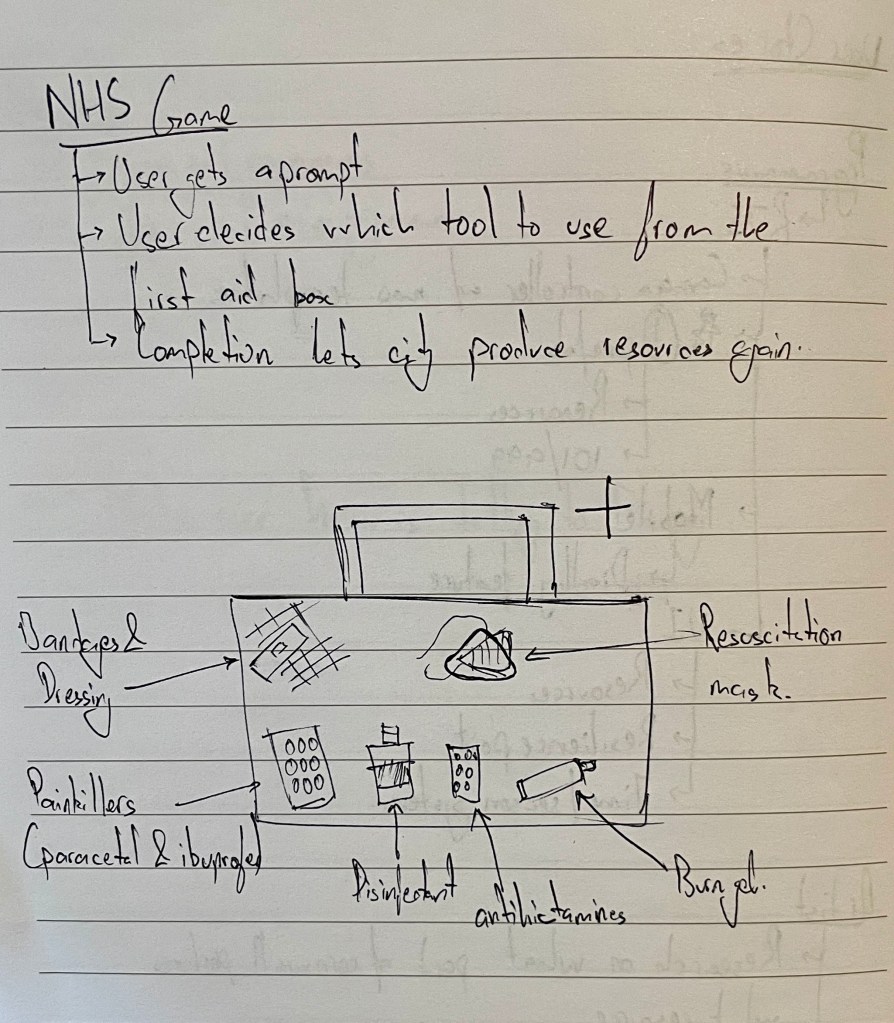
- NHS — Teach kids on how to use the first aid kit with drag and drop mechanics
- Police — Aims to teach kids to be aware of suspicious vehicles and police road duties with driving mechanics.
- Mountain Rescue — Aims to teach kids the dangers of mountain climbing and mountain rescue operations, using mechanics similar to the fishing game in club penguin
- Firefighting — Aims to teach kids about the different kinds of fire extinguishers using drag and drop mechanics
- Coast Guard — Aims to teach kids the difference between high and low tides and how to prepare for it, using warning mechanics and a mechanic where the player throws life preservers.
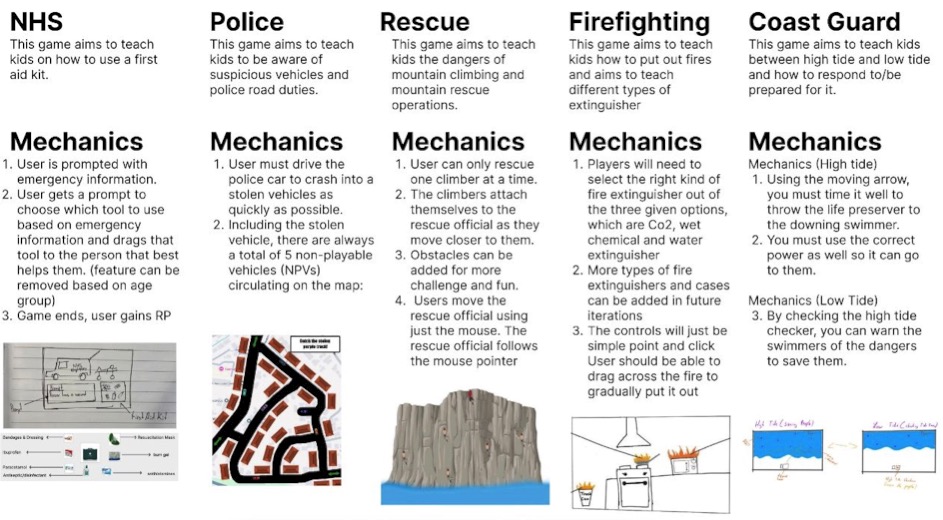
I helped with coming up with the ideas for the NHS and the Fire fighting mini games. Since we had 5 designers, the task of creating GDDs for each of the games got split between the 5 of us, I was in charge of creating the GDD for the NHS mini-game.
Project supervisor feedback
When we had a meeting with our project supervisor, he had mentioned that the more the game was educational, the more it made sense. And we were advised to remove atleast one game due to scope, and to rework another game since it lacked that educational lens.
For the final version of the game, we ended up removing 2 of the mini games for the same reasons mentioned. We eventually ended up developing the NHS, firefighting, and the coastguard mini game only. Out of those, the coastguard mini-game couldn’t be fully developed because of scope.
Bibliography
G. SINGER, Dorothy, Roberta Michnick GOLINKOFF and Kathy HIRSH-PASEK. 2006. Play = Learning.
G. SINGER, Dorothy and Jerome L. SINGER. 2005. Imagination and Play in the Electronic Age.
 Avi
Avi 
Leave a comment