
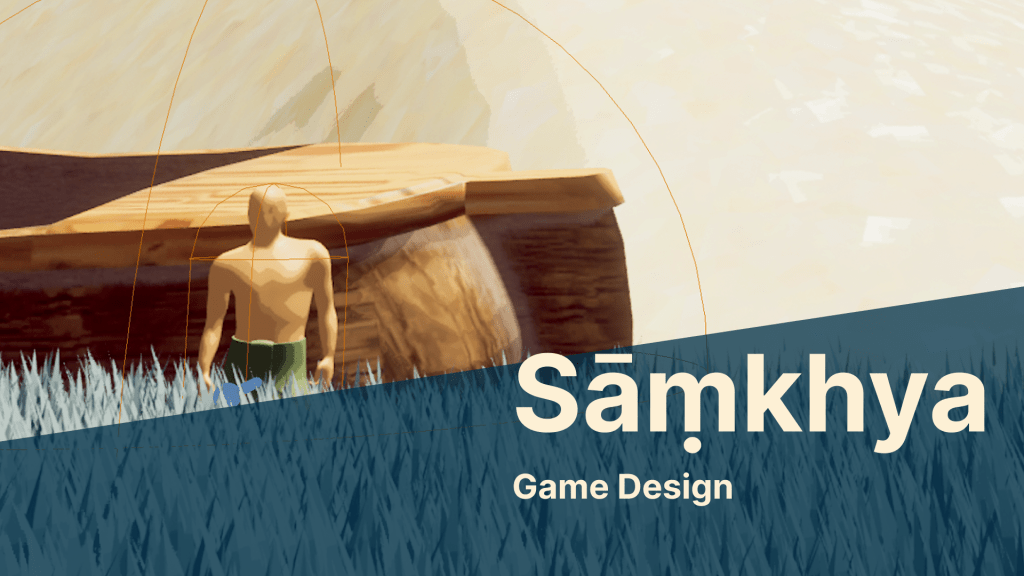
Having gathered all of the prior information, I wanted to design a game that fits into everything I’ve worked on.
Taking inspiration from The First Tree, I made a simple outline for the mechanics of the levels of the game
Overarching Design
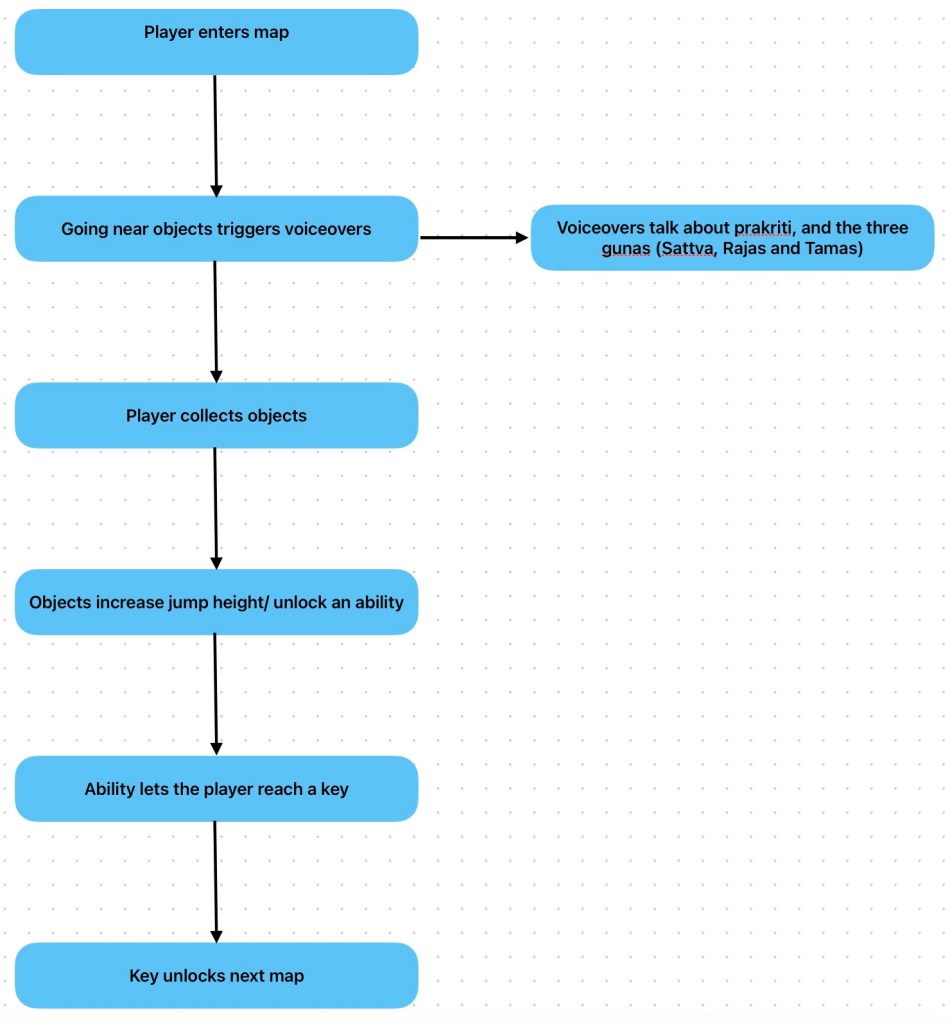
The overarching design was going to be a hub and spoke design, with influence from Super Mario Odyssey.
I was quite heavily influenced from Super Mario’s hub being a ship who’s sails need to be built with each passing level.
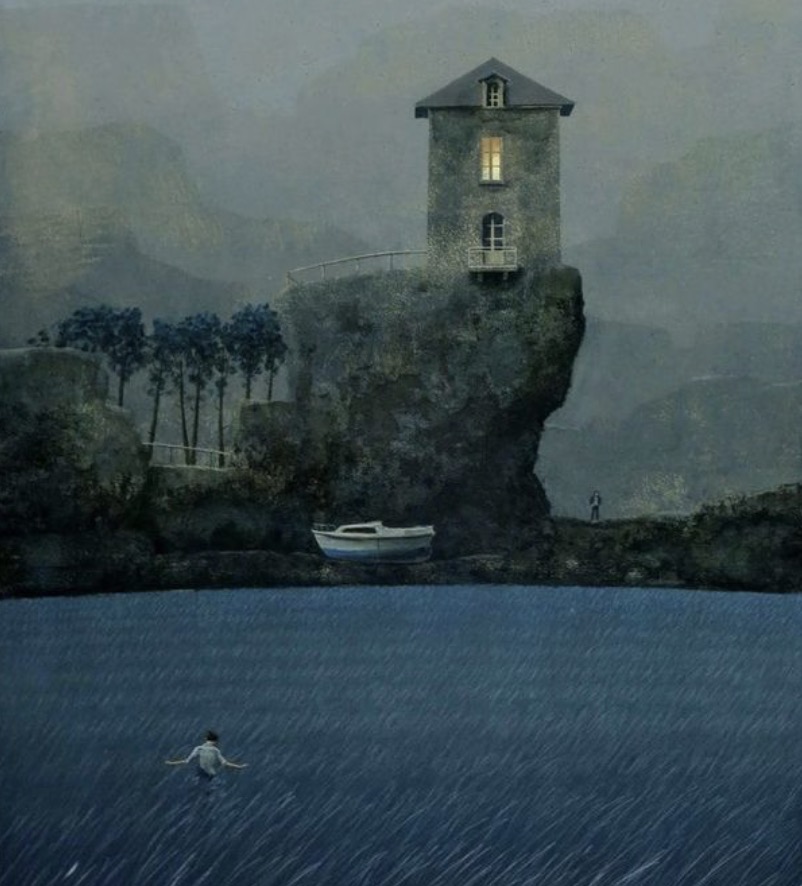
My game’s hub was going to be a dry landscape with a boat. The player would have to navigate through the various levels to be able to build the ship to travel to Yama.
The art of this landscape was influenced by an artist, Phillipe Charles Jacquet (‘PHILIPPE CHARLES JACQUET’ 2025)

Level Design
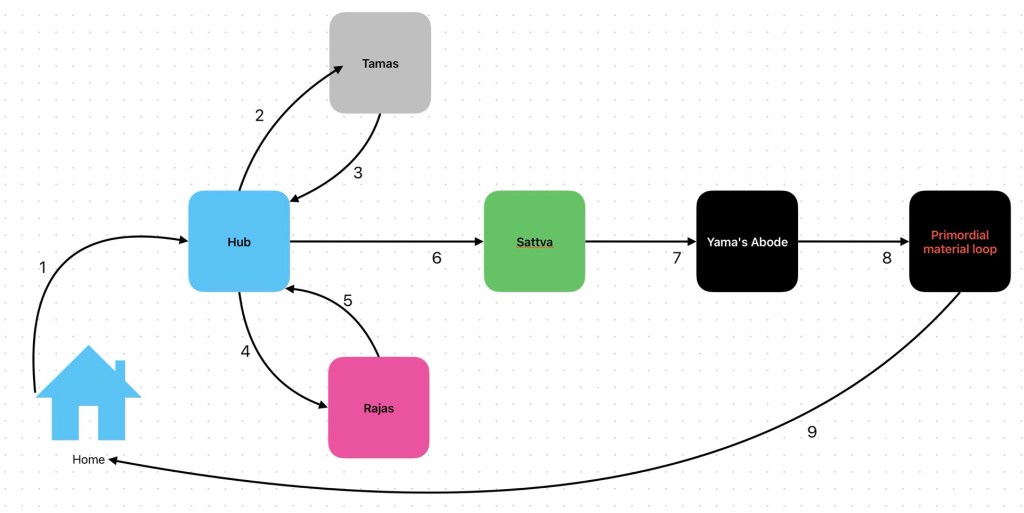
The hub was going to split into 3 levels – Tamas, Rajas and Sattva.
Each level signifies a characteristic of the human nature.
Tamas – Inertia, darkness and ignorance
Rajas – movement, energy, restlessness
Sattva – Light, clarity, knowledge, peace
Tamas
The level design for tamas was going to have to include the feeling of inertia, darkness and ignorance. The user would have to feel dull, depressed or stuck.
The following mechanics were implemented to reinforce that feeling:
- Player can only walk, no sprinting
- Mud slows the player down
- Heavy silences, unsettling sounds
- Player has to collect orbs – not too many, but not too little
- Player could have a sprint timer, like in breath of the wild
- Player would have to activate beacons – each beacon increases the player’s sprint ability
To help visualise the flow and loop of the level, I made a chart
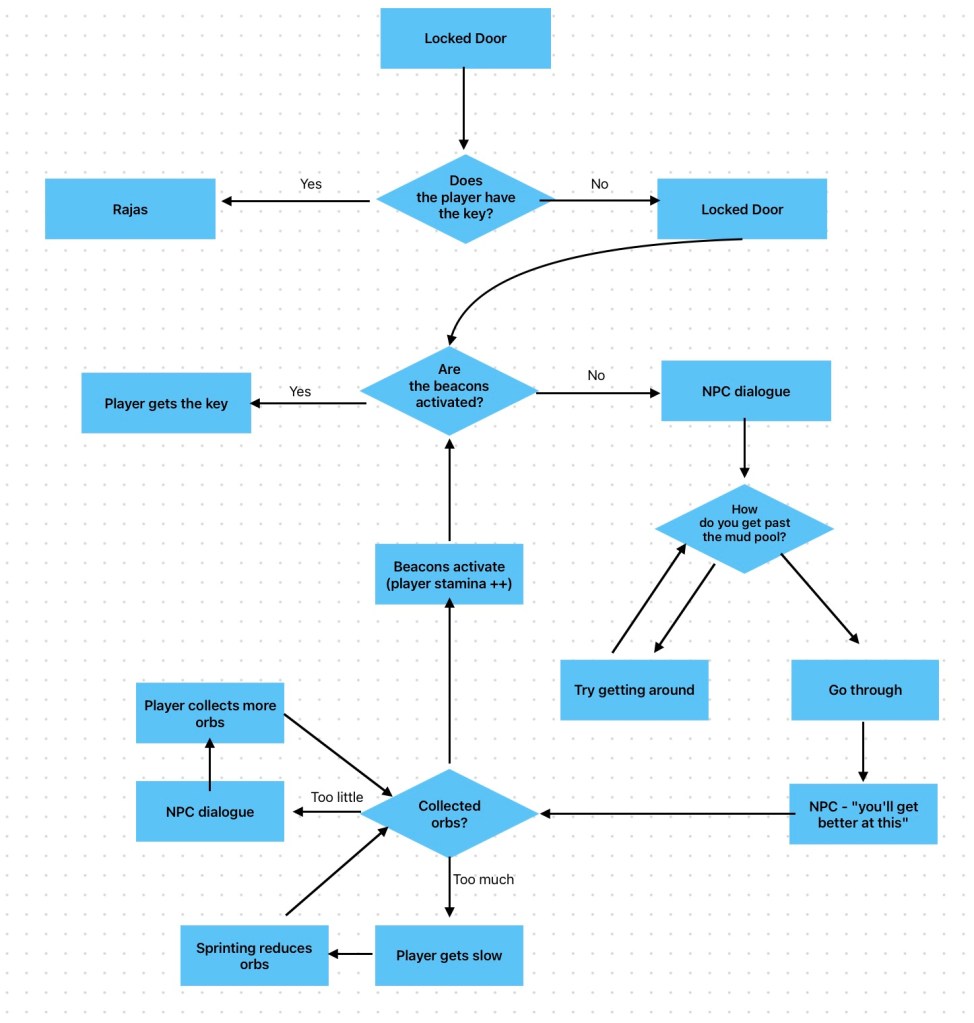
I noticed how this level could possibly turn out to be not fun, because it is meant to invoke the feeling of inertia.
I figured the architecture and visuals would keep the user from getting bored immediately, and if the user can sprint they would be encouraged to keep moving forward.
Using what I had learnt from “an architectural approach to level design”, I made a map illustration so I can sculpt the map later

Rajas
The level design for Rajas was going to have to include fast movement, parkour elements and solid goals to reinforce the feeling of growth, energy and restlessness.
The following mechanics were implemented to reinforce that feeling:
- Arrangement based puzzles (creates frustration, and satisfaction on achieving a goal)
- Parkour based platforming
- Linear level design
To help visualise the flow of the level, I made a chart:
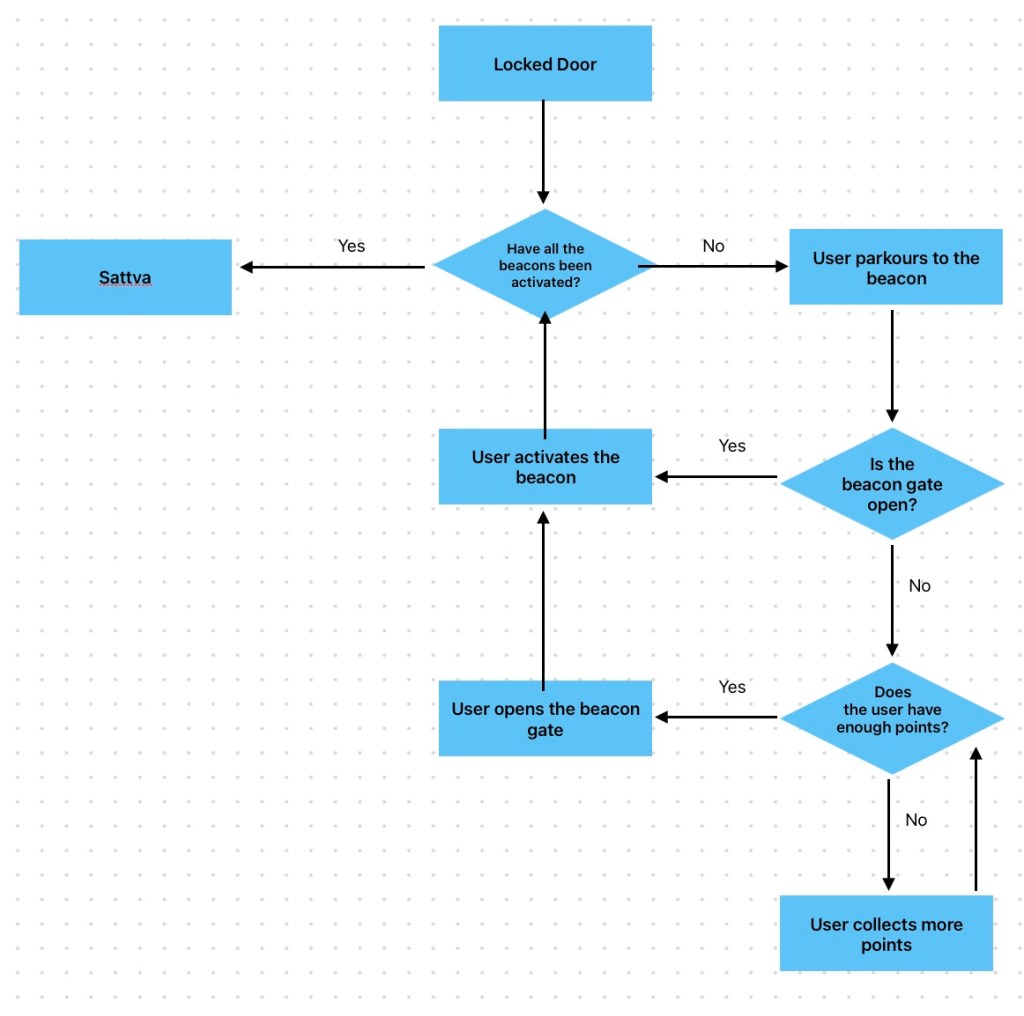
I also made a map illustration to help me sculpt later into the project:

Sattva
Sattva breaks the loop of the last two levels. Sattva is meant to be different, since it is the closest to moksha (liberation), making it in some sense, the bridge between nature and primordial material.
In its essence, Sattva means calmness. It represents light, clarity, and knowledge. One can assume with evidence that knowledge can refer to the understanding that the soul never dies, and one must be detached from their actions through the knowledge that the soul never dies.
To illustrate this, I intended to employ a technique commonly employed in deep games.
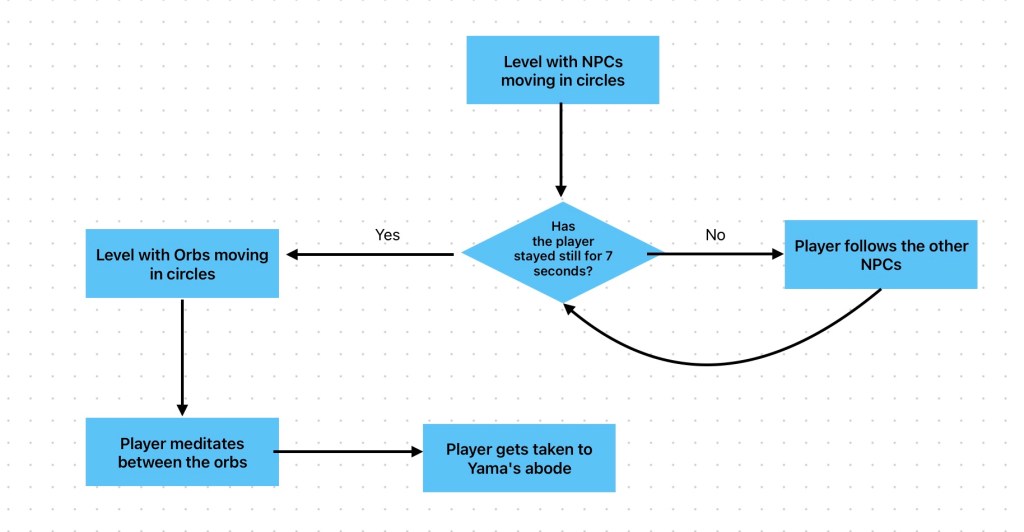
The player would have to walk in a loop following other NPCs. The player has the option of cutting out, or running in the opposite direction as well, but that doesn’t have any effect.
The only way to stop the loop is for the player to step away from their computer. If the player steps away for about 7 seconds, the level changes to one that shows just their souls moving around in a loop, with the player in the centre.
To exit this level, the player would have to meditate, and after meditation, they would be transferred to the ship that takes them to Yama’s abode.
Here is a flowchart to help explain the flow of the level:
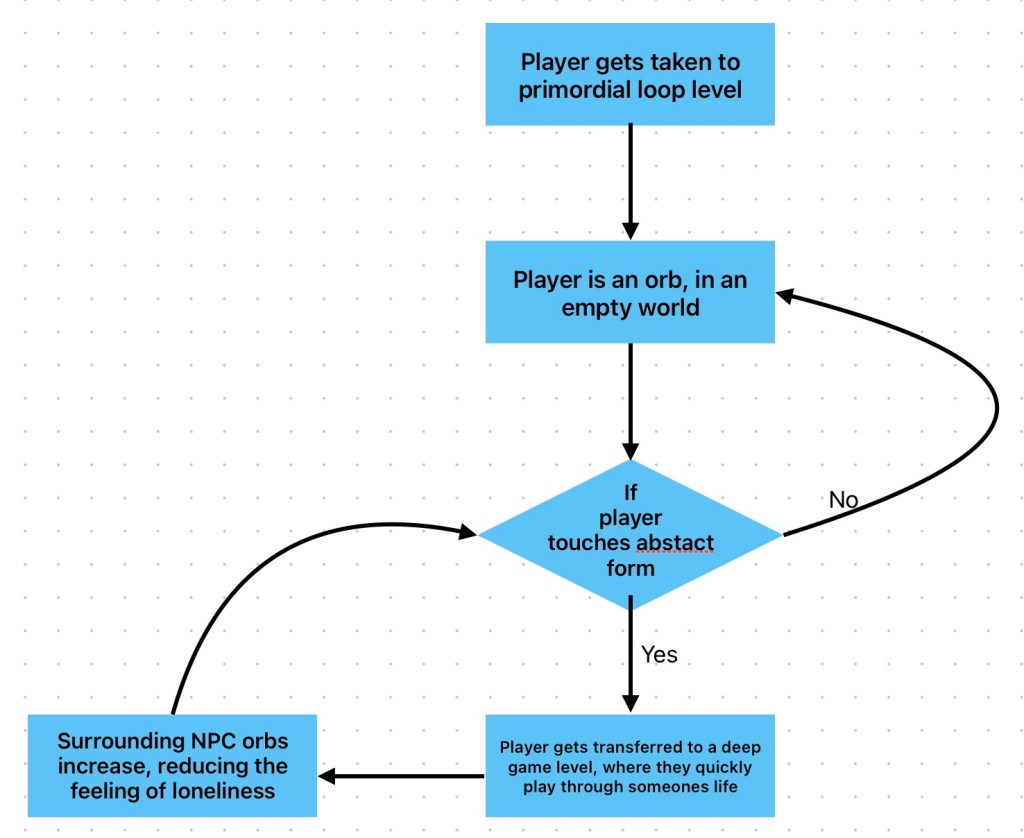
Primordial Material Loop Level
This is the conclusion of the game. Nachiketa travels between the three levels (characteristics of human nature), and makes his way on his ship to Yama’s abode. The ship gets caught up in a storm, and nachiketa mysteriously wakes up on Yama’s abode, his ship broken.
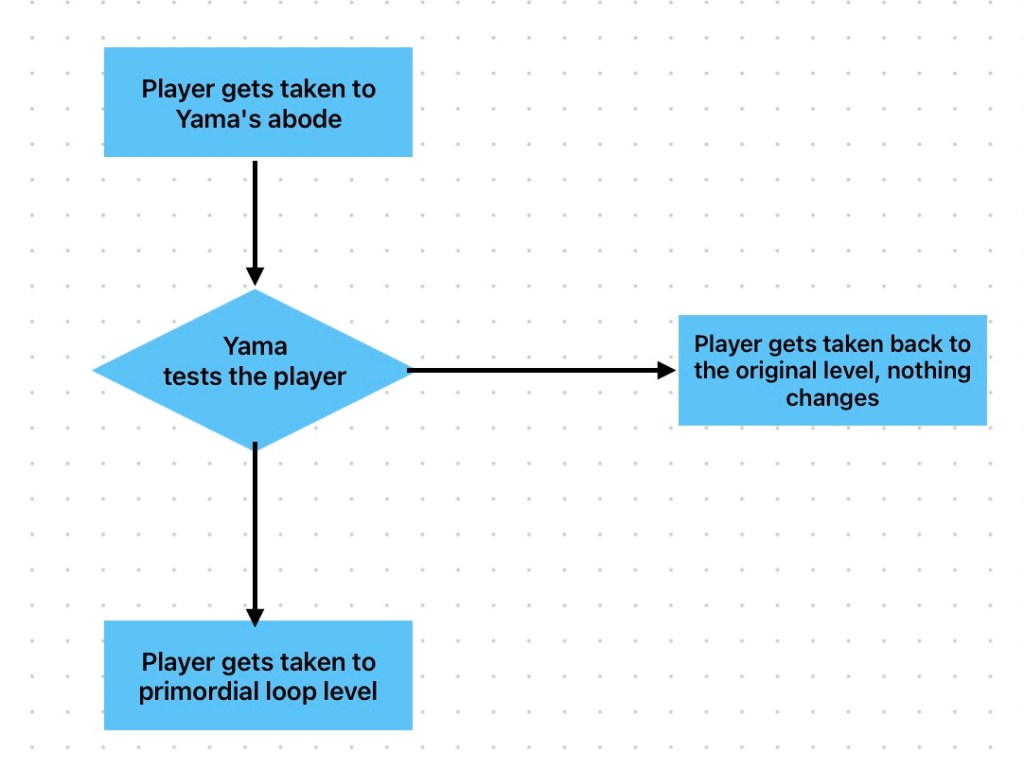
Upon meeting Yama, a dialogue scene is triggered where Yama tests the user after Nachiketa asks him “what happens to the soul after death?”, and if the user passes the test, the player is transported to a primordial material loop level.
Here, the user is an orb in a dark environment, representing a soul, searching for anything, any trace of anything.
In the distance is an abstract form, upon going near, they are given a body, and shown a life. This represents the line from samkhya, “The universe begins when primordial material comes into proximity with nature”.
Meditation Mechanics
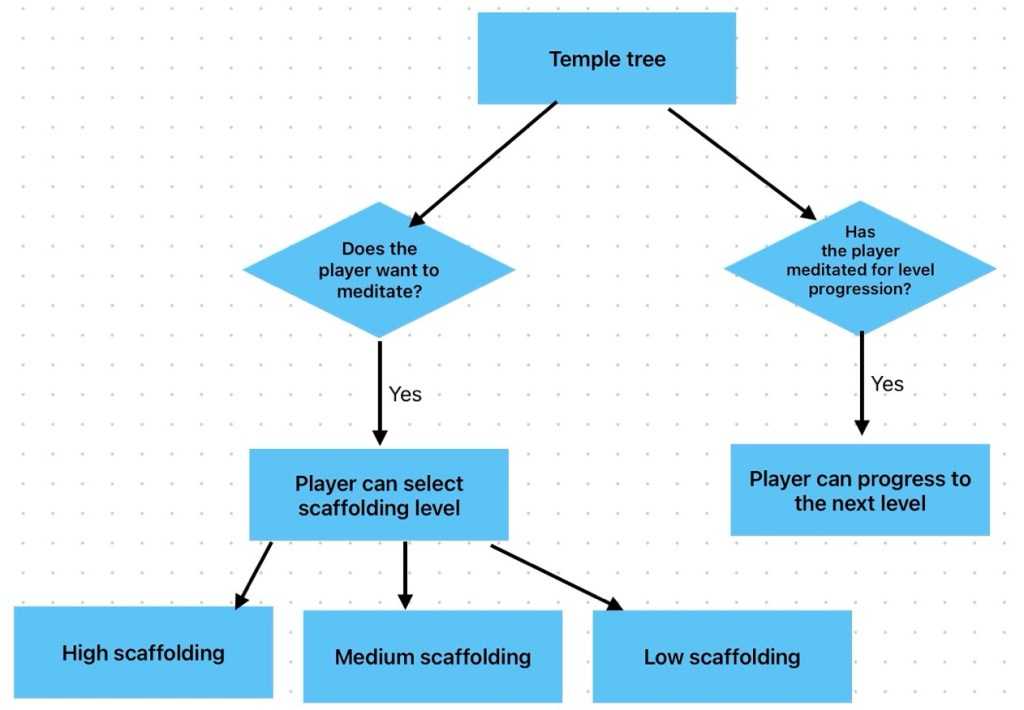
Using the knowledge gained from the research done previously, I knew that the meditation mechanics had to have scaffolding mechanics, shouldn’t feel too forced, and has to be short and simple, to keep the user’s attention.
The meditation window would be prompted in the hub, when the user goes to the temple and sits under the tree.
The user would be given two options — meditate with scaffolding, or meditate for level progression.
Through the game, the user would have to meditate only 3 times to progress through the game. But if they wish, they can meditate more using the scaffolding menu.
Bibliography
‘3D Painting Software for Texturing – Adobe Substance 3D’. 2025. [online]. Available at: https://www.adobe.com/uk/products/substance3d/apps/painter.html [accessed 24 Aug 2025].
4, 898 Views 1 Year Ago. 2025. ‘Sandeep Das’. YouTube [online]. Available at: https://www.youtube.com/channel/UCnbtxwILTDgqPQMhBSdQXJQ [accessed 24 Aug 2025].
112 Upanishads ( Sanskrit Text, English Translation, An Exhaustive Introduction Index Of Verses) 2 Volume Set. n.d. Available at: http://archive.org/details/112-upanishads-sanskrit-text-english-translation-an-exhaustive-introduction-inde [accessed 23 Aug 2025].
‘(118) Designing a Trance: Meditation and Game Design – YouTube’. 2025. [online]. Available at: https://www.youtube.com/watch?v=zZ8BFsdbem0 [accessed 17 Feb 2025].
‘(212) What Does Surapadma and His Brothers Represent? – YouTube’. 2024. [online]. Available at: https://www.youtube.com/ [accessed 7 Dec 2024].
‘(391) History of Yoga Full Film English – YouTube’. 2025. [online]. Available at: https://www.youtube.com/ [accessed 22 Aug 2025].
‘(391) OM CHANTING 10 Minutes | 432Hz Om Mantra to Raise Positive Energy Vibrations – YouTube’. 2025. [online]. Available at: https://www.youtube.com/ [accessed 22 Aug 2025].
‘(395) How To Create Cel-Shading In Unreal Engine 4/5 (Tutorial) – YouTube’. 2025. [online]. Available at: https://www.youtube.com/ [accessed 24 Aug 2025].
‘(395) UE5 | UE4 Tutorial : Cel – Toon Shader – YouTube’. 2025. [online]. Available at: https://www.youtube.com/[accessed 24 Aug 2025].
‘(397) Rāga Kambhoji– A Flute’s Sacred Flow by K. Kamalavaasan – YouTube’. 2025. [online]. Available at: https://www.youtube.com/ [accessed 25 Aug 2025].
‘A Rasa Reader | Columbia University Press’. 2025. [online]. Available at: https://cup.columbia.edu/book/a-rasa-reader/9780231173919/ [accessed 17 June 2025].
‘Coolors – The Super Fast Color Palettes Generator!’ 2025. Coolors.co [online]. Available at: https://coolors.co/ [accessed 24 Aug 2025].
‘Dashavatara Temple, Deogarh’. 2025. Wikipedia. Available at: https://en.wikipedia.org/w/index.php?title=Dashavatara_Temple,_Deogarh&oldid=1297661564 [accessed 23 Aug 2025].
DEHEJIA, Vidya. 1990. ‘On Modes of Visual Narration in Early Buddhist Art’. The Art Bulletin 72(3), 374–92.
‘File:Deogarh01.Jpg – Wikipedia’. 2005. [online]. Available at: https://commons.wikimedia.org/wiki/File:Deogarh01.jpg[accessed 23 Aug 2025].
‘Firewatch: Out Now for Windows, Nintendo Switch, PlayStation 4, Mac, and Linux’. 2025. Firewatch [online]. Available at: http://www.firewatchgame.com/ [accessed 23 Aug 2025].
‘FLORENCE – ANNAPURNA INTERACTIVE’. 2025. Annapurna [online]. Available at: https://www.annapurna.com/interactive/florence [accessed 28 Aug 2025].
‘Freesound’. 2025. [online]. Available at: https://freesound.org/ [accessed 24 Aug 2025].
‘Freesound – Piano for Meditation by SergeQuadrado’. 2025. [online]. Available at: https://freesound.org/people/SergeQuadrado/sounds/740607/ [accessed 5 Mar 2025].
‘Freesound – Ten Minute Meditation Timer by Stomachache’. 2025. [online]. Available at: https://freesound.org/people/stomachache/sounds/474623/ [accessed 5 Mar 2025].
KAGAN, Noah. 2024. Million Dollar Weekend. Available at: https://www.penguin.co.uk/books/448467/million-dollar-weekend-by-kagan-noah/9781529146189 [accessed 23 Aug 2025].
‘Kailasa Temple, Ellora’. 2025. Wikipedia. Available at: https://en.wikipedia.org/w/index.php?title=Kailasa_Temple,_Ellora&oldid=1304202494 [accessed 25 Aug 2025].
‘KAMI’. 2025. State of Play [online]. Available at: https://www.stateofplaygames.com/kami [accessed 25 Aug 2025].
LANKOSKI, Petri. 2024. Game Design Research: An Introduction to Theory & Practice. Carnegie Mellon University. Available at: https://kilthub.cmu.edu/articles/journal_contribution/Game_Design_Research_An_Introduction_to_Theory_Practice/6686750/1[accessed 22 Aug 2025].
LUKOFF, Kai et al. 2020. ‘From Ancient Contemplative Practice to the App Store: Designing a Digital Container for Mindfulness’. In Proceedings of the 2020 ACM Designing Interactive Systems Conference. 1551–64. Available at: http://arxiv.org/abs/2006.09521 [accessed 4 Feb 2025].
‘Meditation – Free Pack’. 2025. SampleMe | Unique Female Vocal Samples [online]. Available at: https://sampleme.sellfy.store/p/meditation-free-pack/ [accessed 5 Mar 2025].
‘Mixamo’. 2025. [online]. Available at: https://www.mixamo.com/#/ [accessed 24 Aug 2025].
‘Mundeshwari Temple’. 2025. Wikipedia. Available at: https://en.wikipedia.org/w/index.php?title=Mundeshwari_Temple&oldid=1300985846 [accessed 23 Aug 2025].
‘Oriental Scenery Part 5 Fig 13 – Mundeshwari Temple – Wikipedia’. 2025. [online]. Available at: https://en.wikipedia.org/wiki/Mundeshwari_Temple#/media/File:Oriental_Scenery_Part_5_Fig_13.jpg [accessed 25 Aug 2025].
Pather Panchali [Film]. 1955. Government of West Bengal.
‘(PDF) A STUDENT’S HANDBOOK OF INDIAN AESTHETICS NEERJA A CONTENTS’. 2025. ResearchGate[online]. Available at: https://www.researchgate.net/publication/357866846_A_STUDENT’S_HANDBOOK_OF_INDIAN_AESTHETICS_NEERJA_A_CONTENTS[accessed 17 June 2025].
‘PHILIPPE CHARLES JACQUET’. 2025. M Fine Arts Galerie [online]. Available at: https://www.mfinearts.com/philppe-charles-jacquet [accessed 23 Aug 2025].
‘Pixar One Twenty Eight’. 2025. [online]. Available at: https://renderman.pixar.com/pixar-one-twenty-eight [accessed 24 Aug 2025].
Samkhya #1 [Film]. 2025. Available at: https://www.youtube.com/watch?v=1YNd49zKGr8 [accessed 25 Aug 2025].
‘Samkhya by Avi Parmar’. 2025. itch.io [online]. Available at: https://aviparmar.itch.io/samkhya [accessed 26 Aug 2025].
SCHELL, Jesse. 2008. The Art of Game Design.
‘Screenwriting & Storytelling Blueprint: Hero’s Two Journeys’. 2025. Udemy [online]. Available at: https://www.udemy.com/course/screenwriting-story-blueprint-the-heros-two-journeys-filmmaking/ [accessed 23 Aug 2025].
‘Sound Effects Library – Free Sound Effects | Adobe Audition’. 2025. [online]. Available at: https://www.adobe.com/products/audition/free-sound-effects.html [accessed 24 Aug 2025].
‘Stylized Rock Modular Kit’. 2025. Fab.com [online]. Available at: https://www.fab.com/listings/1aca9571-d2c6-4a22-a8e2-f154545a425f [accessed 23 Aug 2025].
‘Stylized Trees Pack’. 2025. Fab.com [online]. Available at: https://www.fab.com/listings/7ca321e2-f590-4fb8-8435-215f53216322 [accessed 23 Aug 2025].
‘Super Mario OdysseyTM for the Nintendo SwitchTM Home Gaming System – Official Game Site’. 2025. Super Mario OdysseyTM for the Nintendo SwitchTM home gaming system – Official Game Site [online]. Available at: https://supermario.nintendo.com/ [accessed 23 Aug 2025].
‘Tacoma on Steam’. 2025. [online]. Available at: https://store.steampowered.com/app/343860/Tacoma/ [accessed 23 Aug 2025].
‘The Encyclopedia of Indian Philosophies, Volume 4: Samkhya, A Dualist … – Gerald James Larson, Ram Shankar Bhattacharya – Google Books’. 2025. [online]. Available at: https://books.google.co.in/books?hl=en&lr=&id=bqr_AwAAQBAJ&oi=fnd&pg=PP1&dq=philosophy+of+samkhya&ots=85Dpyreu1D&sig=dLe-85tC1EK3Huxv_Q7nsh_pzKc&redir_esc=y#v=onepage&q=philosophy%20of%20samkhya&f=false [accessed 17 June 2025].
‘The First Tree – A Beautiful 3rd-Person Exploration Game’. n.d. [online]. Available at: https://www.thefirsttree.com/[accessed 23 Aug 2025].
TOTTEN, Christopher W. 2019. Architectural Approach to Level Design: Second Edition. 2nd edn. New York: A K Peters/CRC Press.
YAJNADEVAM. 2024. A Cryptanalytic Decipherment of the Indus Script. Available at: http://archive.org/details/a-cryptanalytic-decipherment-of-the-indus-script [accessed 23 Aug 2025].

 Avi
Avi 


Leave a comment