
The Planning Phase
Research in Game Design
Before starting the project, I thought it was important to understand what exactly was research in the field of game design.
I read a bit of “Game Design Research: An introduction to theory and practice”(Lankoski 2024) to guide me through this.
Game Design Research is merely a by-product of “How do we create this specific game?”, and research is split to research on design, for design and through design.
In terms of research led practice and practice led research, this project is more aligned towards research led practice, where I am trying to create an artefact using other research.
State of the art technologies
- Meditation
I was determined to explore the meditation aspect of the game, as it had unrealised potential in a previous prototype of a similar concept that I hade made.
I wanted to explore the effects of meditation mechanics on derealisation, and how it can be used to better tell a story.
I also wanted to implement meditation mechanics because of its positive effect on the users mental health.
- Potential for Virtual Reality
I wanted to make a game for VR platforms, since meditation games in VR platforms has a huge potential to grow.
But during production, I realised it was difficult for me to have access to VR technology like the oculus in a manner that would make it comfortable to build and prototype for continuously, especially if the scope of the project was going to be big.
To make up for it, I made the whole project as a first-person game, so that it can also be ported to VR much more easily.
The Research Phase
Samkhya
For researching on Samkhya, I referred to a chapter from the encyclopaedia of Indian philosophies, called “Samkhya: a dualist philosophy” (‘The Encyclopedia of Indian Philosophies, Volume 4: Samkhya, A Dualist … – Gerald James Larson, Ram Shankar Bhattacharya – Google Books’ 2025). I also referred to a video explaining the role of ego in indian mythological demons (‘(212) What Does Surapadma and His Brothers Represent? – YouTube’ 2024).
Evidence suggests that Samkhya stands at the fountainhead systematic indian reflection, and has a ubiquitous influence in south asian cultural life.
Samkhya as Enumeration
Samkhya literally means “enumeration” or “relating to number”
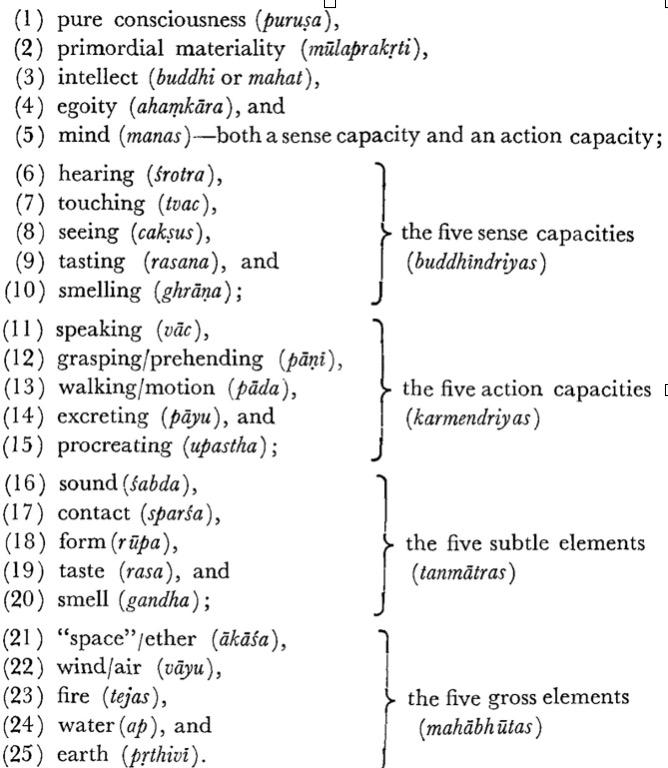
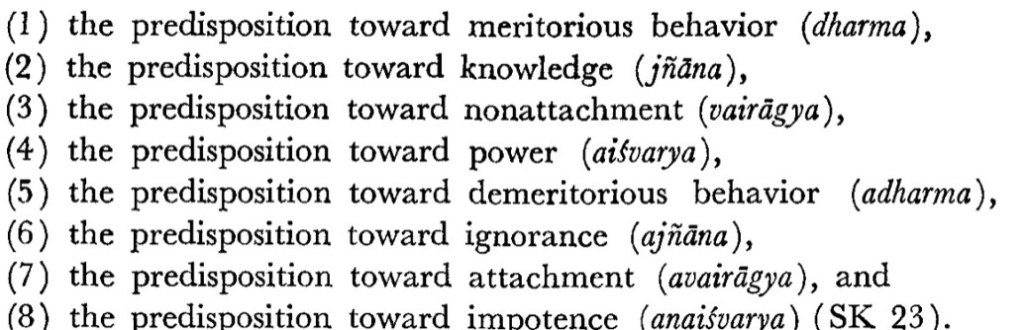
This is because Samkhya describes various sets of enumerations. Here are a few that serve as good examples:
- The set of 25 basic principles
- The set of predispositions
3. The set of realms
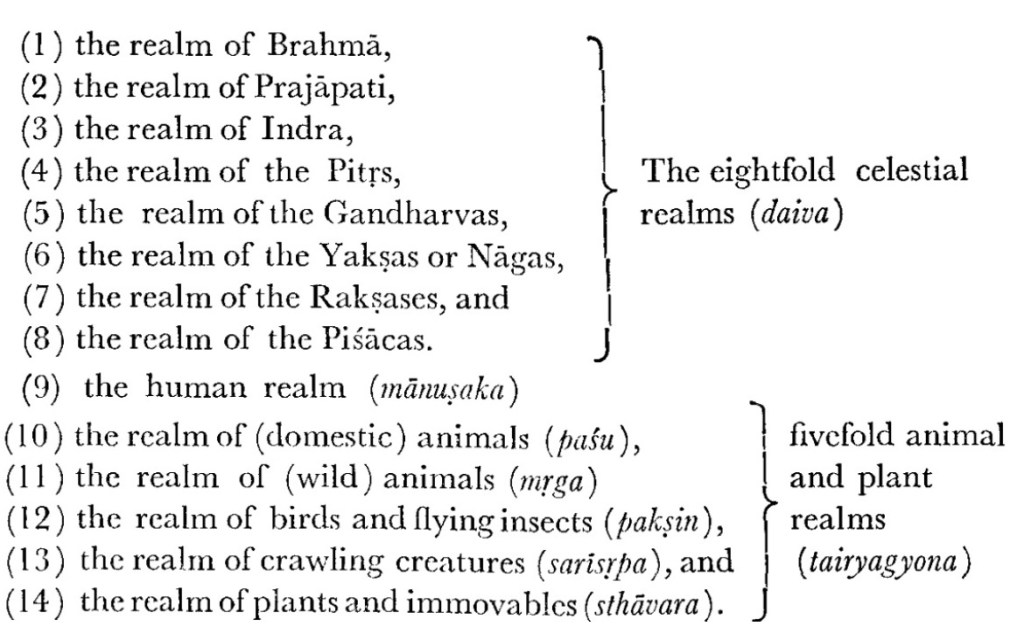
The three gunas of prakriti
In Samkhya, there are three gunas (fundamental qualities) of prakriti (nature).
- Sattva
Brings balance, stability, and a sense of higher purpose.
- Rajas
Creates activity and change, but also desire and unrest.
- Tamas
Causes heaviness, dullness, and resistance
I also like to relate these three aspects of nature to the explanation of what Surapadma (a demon in hindu stories) represents.
Surapadma and his two brothers indicate the 3 blemishes that every human soul has – the “I” (ego), karma and Maya (illusion).
Metaphors from Samkhya
Metaphors are a great way to explore the directions a project could take,
One of the metaphors that gets repeated alot is of a flame. One can imagine tamas to be the wick of the flame, rajas as the flame itself, and the brightness that replaces the darkness as Sattva.
Another metaphor that gets told often, is of prakriti (nature) and purusha (primordial matter), where prakriti s described o be the dancer, and purusha the spectator of the dancer.
Yoga
While watching this documentary on yoga(‘(391) History of Yoga Full Film English – YouTube’ 2025), I made some interesting observations:
- Sounds of a Durga festival depict Samkhya
- Yoga is the practice of Samkhya
- The origin of the universe is from sound, and primordial sound still resonates in different layers of our consciousness.
- At some point in history, the university of Nalanda was very focused on trying to figure out how to make the human body immortal.
- In samkhya, art has a dual purpose – for the artist, it is a test of his meditation, and for the viewer, the potential for it to permeate his heart.
Meditation
Since this was a meditative game, a large part of my research was also going to be on meditation. For the resources I used, I found a GDC talk ‘designing a trance’(‘(118) Designing a Trance: Meditation and Game Design – YouTube’ 2025), and a research paper ‘from ancient contemplative practices to the app store’(Lukoff et al. 2020) to be quite helpful.
Designing a Trance
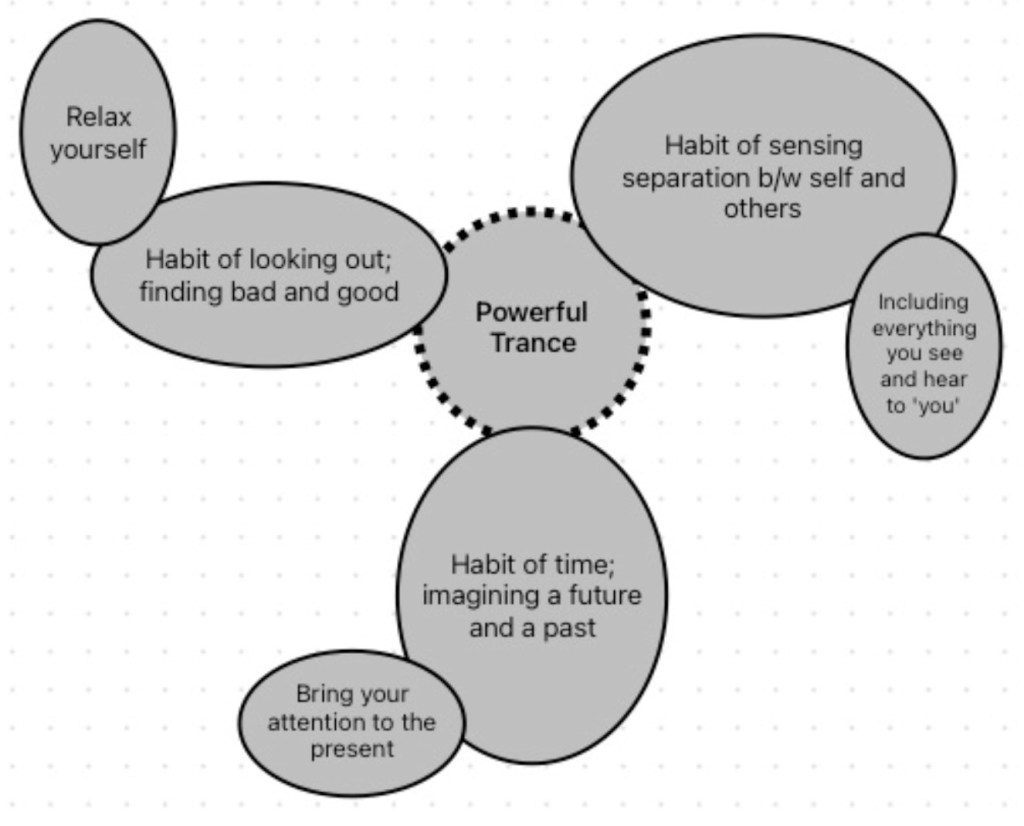
This was probably the most influential resource for the meditation mechanics in this game, since it provided a really good framework on how to design meditation loops.
A powerful trance is a result of looking for the bad and good, sensing your surroundings, and focusing on the passing of time.
A good meditation practice is a result of breath work and observing your mind.
Some important points to note:
- A trance is a self perpetuating mental loop.
- In order to enter a trance, we need self-perpetuating mental loops.
- You can feel the feeling of your thoughts, which can be referred to as somewhat of a ‘qualia of thoughts’.
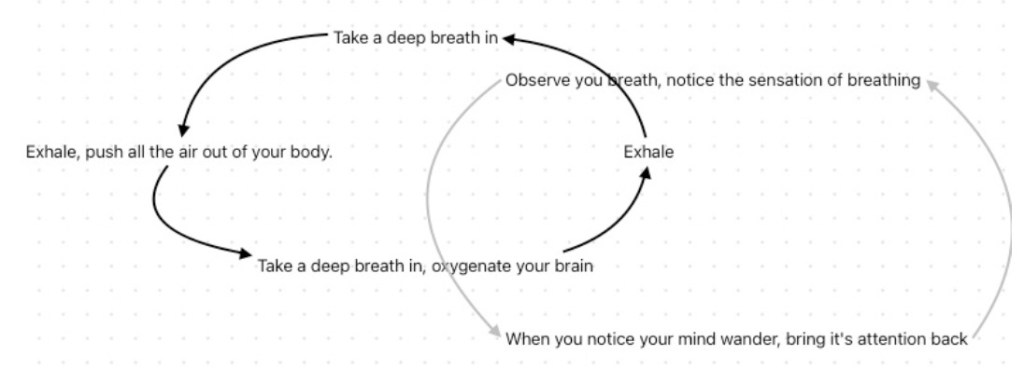
Ancient Contemplative Practices to the App Store
This research paper provided a framework on how to develop meditative experiences on digital platforms, with critiques from ancient contemplative masters.
A common theme through the research paper seemed to be on the topic of scaffolding in meditation, where the researchers wrote about how different people need different kinds of scaffolding through their meditation experiences, and mediation apps fail to provide that since they have to cater to a larger audience.
This research paper also served as a good reference for some design guidelines:
1. Designing for less dependence — the designer could omit soothing visuals and sounds.
2. Gradually reducing scaffolding — technologies should gradually shift students to lesser reliance on extrinsic processes.
3. Transfer mindfulness — from formal to informal practice to everyday life.
Playing other games
I tried out a couple games of a similar feel to what I was aiming for.
Since this was a meditative game, a lot of the inspiration came from other games of a similar vibe, mostly walking simulators.
Firewatch
While making this game, I kept feeling like all roads led to making a walking simulator of some sort, so I tried to observe Firewatch(‘Firewatch: Out Now for Windows, Nintendo Switch, PlayStation 4, Mac, and Linux’ 2025).
Firewatch has an incredible opening, where the developer has sold the feeling of the game using text and ambience only, which I decided to implement in my game since it was the shortest path to getting the feel of the game across.
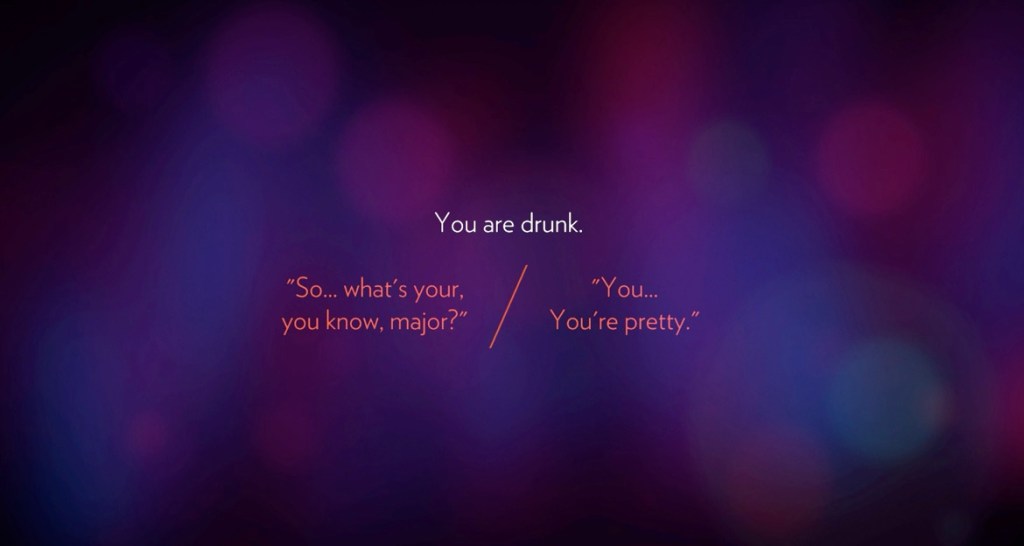
Firewatch also does an incredible job at teaching the games’ mechanics through intermediary moments of gameplay, and building character backstories, and then breaking it through the game.
Tacoma
Tacoma(‘Tacoma on Steam’ 2025) was another indie game that had a few similar things going on. I couldn’t play much of the game since it was just for studying,
But I found the hub and spoke level design to be really interesting, with the rotating spaceship parts, and the way the story exposure takes such a different approach from fire watch, and just directly throws the player into the chaos.
Super Mario Odyssey
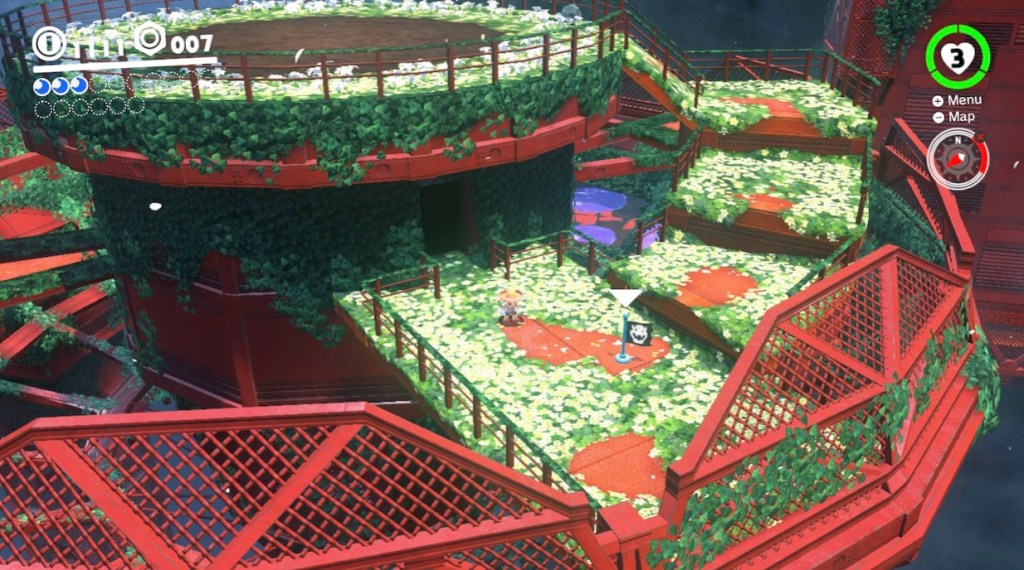
Super Mario Odyssey(‘Super Mario OdysseyTM for the Nintendo SwitchTM Home Gaming System – Official Game Site’ 2025) had a lot of different mechanics going on, and was a great eye opener for level designing and mechanics designing.
I often got complaints with my last game that explored a similar theme, that the game just wasn’t fun or immersive enough, and I wanted to change that with this game.
Super Mario had the most to offer in terms of learnings, for instance, I often thought about how the duality of environments could play its part in the level design, how overlapping terrains could show two realms intersecting, how all elements in a level must have some level of interaction, and add to the story, in the same way that every frame of a movie has to have something to offer to a viewer.
I thought about lava pools as well, and simple mechanics like collecting all the moons in the level to pass to the next one.
Partially inspired by Zelda, I also thought about how temple architecture could be used to make platformers.
Maybe most importantly however, I noticed how Mario’s hub, was a ship who’s sails were being built as each level passed on to the next. This would play a role later when I started designing the levels.
While Mario’s hat-throwing mechanics are too complex for the scope of this project, the game as a whole still served as a valuable learning experience for level design.
The First Tree
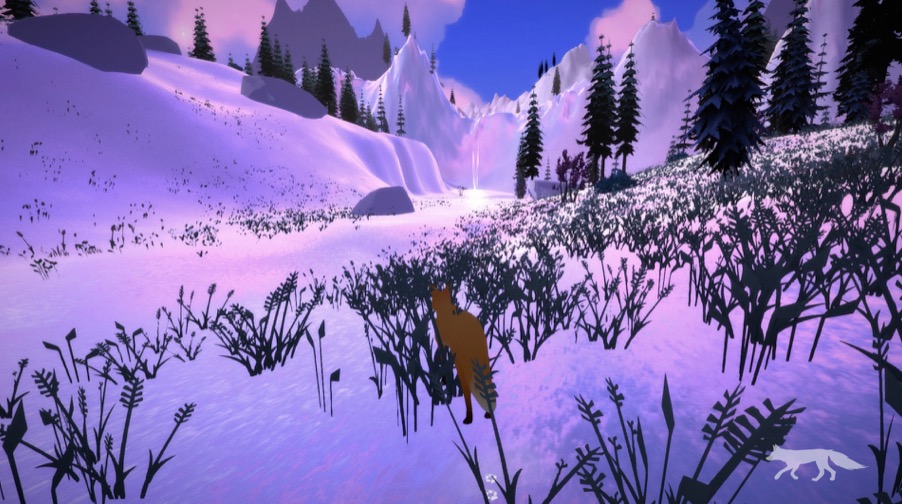
This game was a huge inspiration, since it showed me what an indie developer could do.
Its walking simulator mechanics, with zone activated dialogues eventually made it into my game as well.
Its walking mechanics, and visual composition served as good inspiration for my game.
Journey
Journey’s (‘The First Tree – A Beautiful 3rd-Person Exploration Game’ n.d.) simple art style, with cel shading, and its simple ‘collect the orbs’ and ‘activate the beacons’ played a huge role in making my game.
It also served as good inspiration for how I can tell a story through my game, especially the end when it ends without a conclusion.
Florence
Florence(‘FLORENCE – ANNAPURNA INTERACTIVE’ 2025) was an incredible deep game with a linear storyline, and simple gameplay mechanics that tried to sell the feel of the narrative.
Game Art
The aesthetics of this game were going to matter a lot, primarily because of my choice of engine (Unreal Engine), and because of the immersion I wanted to bring in.
Cel Shading
I used cel shaders (as a post process effect) in my game for a few reasons.
Cel shading helps differentiate my game from all the other unreal engine games out there, that look like unreal engine games.
It also helps from a narrative aspect, since I can have more control over shadows and ambient occlusion, and I can use cel shaders for prakriti, and regular shaders purusha, which helps differentiate the environments.
Paid Resources
I realised quite quickly that with the amount of 3D models I would have to make, it would be impossible to finish making certain models that get repeated through the game fairly often.
So, I invested in rocks (‘Stylized Rock Modular Kit’ 2025) and trees(‘Stylized Trees Pack’ 2025)
Temple Architecture and Aesthetic
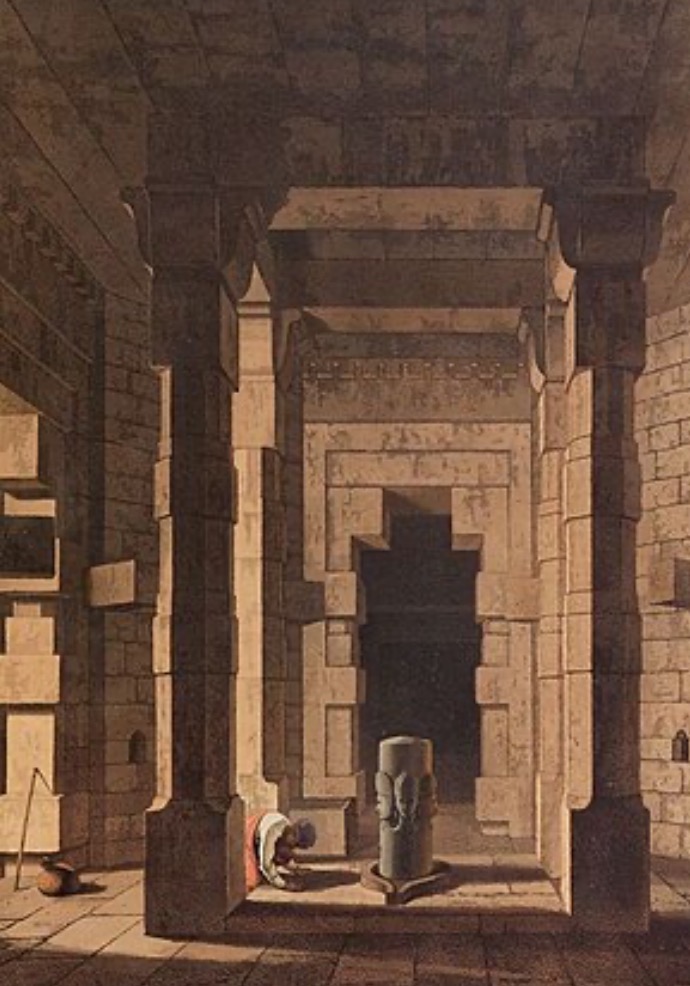
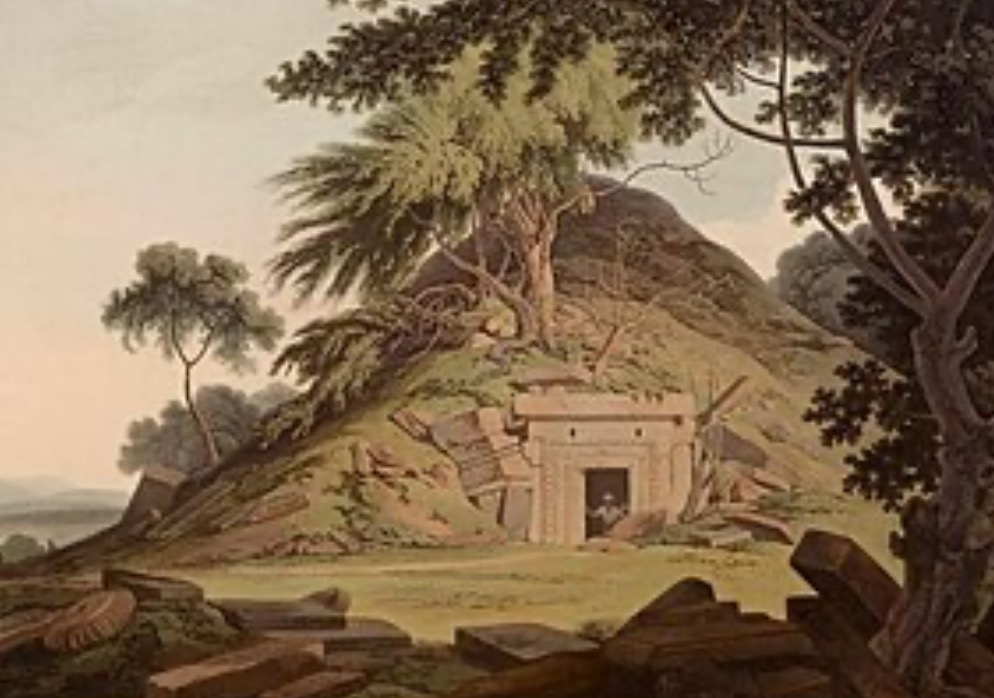
To research on temple architecture, I read up on a bit of Temple Architecture of India (Dr. N. C. Panda and Emani 2018).
This book helped me in understanding the general layout of temples in india, and how pillars and roofs are arranged.
While staying true to to its teachings, I also wanted to stylise it a bit for the user, for which I used references from the Internet of ancient temples such as Mundeshwari Temple(‘Mundeshwari Temple’ 2025), and Dashavatara Temple(‘Dashavatara Temple, Deogarh’ 2025).
I was also recommended “A Rasa Reader” (‘A Rasa Reader | Columbia University Press’ 2025) and “A student’s handbook of Indian Aesthetics”(‘(PDF) A STUDENT’S HANDBOOK OF INDIAN AESTHETICS NEERJA A CONTENTS’ 2025) by William Huber
Having scanned through them, these books helped me build a muscle for the kind of aesthetics I should be aiming for.
I used “ Architecural approach to level design”(Totten 2019) to tie in all the architecture to make levels.
“Modes of narration in early buddhist art”(Dehejia 1990) is also a great study on the nature of sequential art imprints on temple architecture in India.
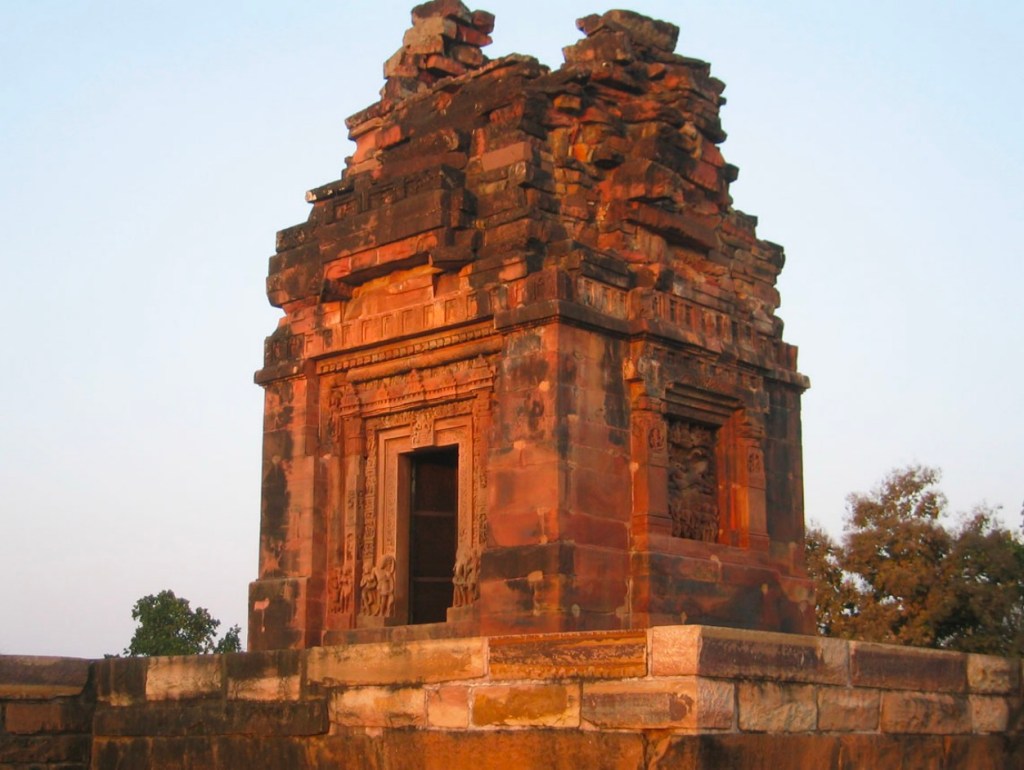
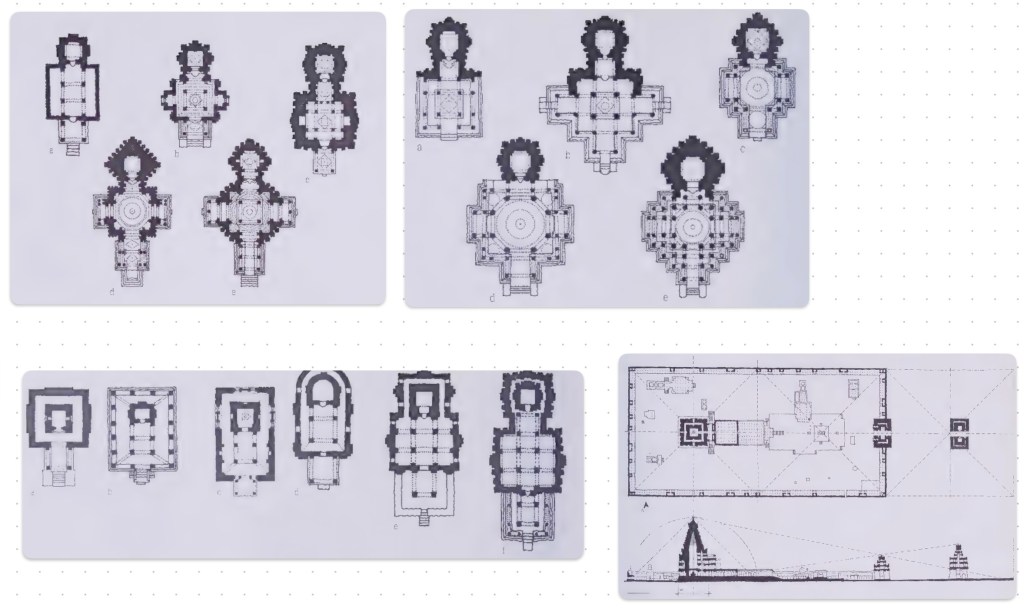
Ancient Indian Civilisations
I did a lot of research on Mohenjodaro and other civilisations of the past, since I thought it would be important to understand the roots of the civilisation before trying to form a piece of art on it.
I found it quite interesting that through time, Indian architecture is inspired by many outsiders, but primarily the Mughals and the Greeks, and much later the British, and differentiating between these is fairly easy. For a while, I was wondering how I could use these different styles in crafting a narrative, but eventually I chose not to go ahead with it since it risks segregating audiences, and might encourage dialogue on Indian invasions, which is not my intention.
I also did a lot of research on the Indus Valley Civilisation, which is the oldest known indian civilisation, and had settled in present day Pakistan and north west India.
Stamps (‘Are Indus Valley Seals Proto – Coins?’ 2025) from these civilisations show many Samkhya references, which prove how old the philosophy is, and give us our oldest traces of a philosophy that is less understood today.
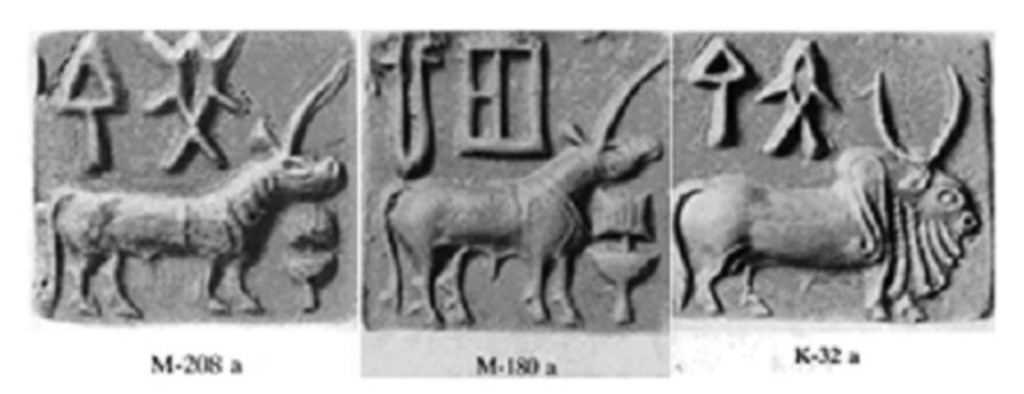
The Indus valley’s language is one of the oldest mysteries, since nobody has been able to decode the language. A cutting edge research paper
(Yajnadevam 2024)aims to decipher the language using pattern recognition and machine learning
This would later be used in the main menu of the game.
Bibliography
‘3D Painting Software for Texturing – Adobe Substance 3D’. 2025. [online]. Available at: https://www.adobe.com/uk/products/substance3d/apps/painter.html [accessed 24 Aug 2025].
4, 898 Views 1 Year Ago. 2025. ‘Sandeep Das’. YouTube [online]. Available at: https://www.youtube.com/channel/UCnbtxwILTDgqPQMhBSdQXJQ [accessed 24 Aug 2025].
112 Upanishads ( Sanskrit Text, English Translation, An Exhaustive Introduction Index Of Verses) 2 Volume Set. n.d. Available at: http://archive.org/details/112-upanishads-sanskrit-text-english-translation-an-exhaustive-introduction-inde [accessed 23 Aug 2025].
‘(118) Designing a Trance: Meditation and Game Design – YouTube’. 2025. [online]. Available at: https://www.youtube.com/watch?v=zZ8BFsdbem0 [accessed 17 Feb 2025].
‘(212) What Does Surapadma and His Brothers Represent? – YouTube’. 2024. [online]. Available at: https://www.youtube.com/ [accessed 7 Dec 2024].
‘(391) History of Yoga Full Film English – YouTube’. 2025. [online]. Available at: https://www.youtube.com/ [accessed 22 Aug 2025].
‘(391) OM CHANTING 10 Minutes | 432Hz Om Mantra to Raise Positive Energy Vibrations – YouTube’. 2025. [online]. Available at: https://www.youtube.com/ [accessed 22 Aug 2025].
‘(395) How To Create Cel-Shading In Unreal Engine 4/5 (Tutorial) – YouTube’. 2025. [online]. Available at: https://www.youtube.com/ [accessed 24 Aug 2025].
‘(395) UE5 | UE4 Tutorial : Cel – Toon Shader – YouTube’. 2025. [online]. Available at: https://www.youtube.com/[accessed 24 Aug 2025].
‘(397) Rāga Kambhoji– A Flute’s Sacred Flow by K. Kamalavaasan – YouTube’. 2025. [online]. Available at: https://www.youtube.com/ [accessed 25 Aug 2025].
‘A Rasa Reader | Columbia University Press’. 2025. [online]. Available at: https://cup.columbia.edu/book/a-rasa-reader/9780231173919/ [accessed 17 June 2025].
‘Coolors – The Super Fast Color Palettes Generator!’ 2025. Coolors.co [online]. Available at: https://coolors.co/ [accessed 24 Aug 2025].
‘Dashavatara Temple, Deogarh’. 2025. Wikipedia. Available at: https://en.wikipedia.org/w/index.php?title=Dashavatara_Temple,_Deogarh&oldid=1297661564 [accessed 23 Aug 2025].
DEHEJIA, Vidya. 1990. ‘On Modes of Visual Narration in Early Buddhist Art’. The Art Bulletin 72(3), 374–92.
‘File:Deogarh01.Jpg – Wikipedia’. 2005. [online]. Available at: https://commons.wikimedia.org/wiki/File:Deogarh01.jpg[accessed 23 Aug 2025].
‘Firewatch: Out Now for Windows, Nintendo Switch, PlayStation 4, Mac, and Linux’. 2025. Firewatch [online]. Available at: http://www.firewatchgame.com/ [accessed 23 Aug 2025].
‘FLORENCE – ANNAPURNA INTERACTIVE’. 2025. Annapurna [online]. Available at: https://www.annapurna.com/interactive/florence [accessed 28 Aug 2025].
‘Freesound’. 2025. [online]. Available at: https://freesound.org/ [accessed 24 Aug 2025].
‘Freesound – Piano for Meditation by SergeQuadrado’. 2025. [online]. Available at: https://freesound.org/people/SergeQuadrado/sounds/740607/ [accessed 5 Mar 2025].
‘Freesound – Ten Minute Meditation Timer by Stomachache’. 2025. [online]. Available at: https://freesound.org/people/stomachache/sounds/474623/ [accessed 5 Mar 2025].
KAGAN, Noah. 2024. Million Dollar Weekend. Available at: https://www.penguin.co.uk/books/448467/million-dollar-weekend-by-kagan-noah/9781529146189 [accessed 23 Aug 2025].
‘Kailasa Temple, Ellora’. 2025. Wikipedia. Available at: https://en.wikipedia.org/w/index.php?title=Kailasa_Temple,_Ellora&oldid=1304202494 [accessed 25 Aug 2025].
‘KAMI’. 2025. State of Play [online]. Available at: https://www.stateofplaygames.com/kami [accessed 25 Aug 2025].
LANKOSKI, Petri. 2024. Game Design Research: An Introduction to Theory & Practice. Carnegie Mellon University. Available at: https://kilthub.cmu.edu/articles/journal_contribution/Game_Design_Research_An_Introduction_to_Theory_Practice/6686750/1[accessed 22 Aug 2025].
LUKOFF, Kai et al. 2020. ‘From Ancient Contemplative Practice to the App Store: Designing a Digital Container for Mindfulness’. In Proceedings of the 2020 ACM Designing Interactive Systems Conference. 1551–64. Available at: http://arxiv.org/abs/2006.09521 [accessed 4 Feb 2025].
‘Meditation – Free Pack’. 2025. SampleMe | Unique Female Vocal Samples [online]. Available at: https://sampleme.sellfy.store/p/meditation-free-pack/ [accessed 5 Mar 2025].
‘Mixamo’. 2025. [online]. Available at: https://www.mixamo.com/#/ [accessed 24 Aug 2025].
‘Mundeshwari Temple’. 2025. Wikipedia. Available at: https://en.wikipedia.org/w/index.php?title=Mundeshwari_Temple&oldid=1300985846 [accessed 23 Aug 2025].
‘Oriental Scenery Part 5 Fig 13 – Mundeshwari Temple – Wikipedia’. 2025. [online]. Available at: https://en.wikipedia.org/wiki/Mundeshwari_Temple#/media/File:Oriental_Scenery_Part_5_Fig_13.jpg [accessed 25 Aug 2025].
Pather Panchali [Film]. 1955. Government of West Bengal.
‘(PDF) A STUDENT’S HANDBOOK OF INDIAN AESTHETICS NEERJA A CONTENTS’. 2025. ResearchGate[online]. Available at: https://www.researchgate.net/publication/357866846_A_STUDENT’S_HANDBOOK_OF_INDIAN_AESTHETICS_NEERJA_A_CONTENTS[accessed 17 June 2025].
‘PHILIPPE CHARLES JACQUET’. 2025. M Fine Arts Galerie [online]. Available at: https://www.mfinearts.com/philppe-charles-jacquet [accessed 23 Aug 2025].
‘Pixar One Twenty Eight’. 2025. [online]. Available at: https://renderman.pixar.com/pixar-one-twenty-eight [accessed 24 Aug 2025].
Samkhya #1 [Film]. 2025. Available at: https://www.youtube.com/watch?v=1YNd49zKGr8 [accessed 25 Aug 2025].
‘Samkhya by Avi Parmar’. 2025. itch.io [online]. Available at: https://aviparmar.itch.io/samkhya [accessed 26 Aug 2025].
SCHELL, Jesse. 2008. The Art of Game Design.
‘Screenwriting & Storytelling Blueprint: Hero’s Two Journeys’. 2025. Udemy [online]. Available at: https://www.udemy.com/course/screenwriting-story-blueprint-the-heros-two-journeys-filmmaking/ [accessed 23 Aug 2025].
‘Sound Effects Library – Free Sound Effects | Adobe Audition’. 2025. [online]. Available at: https://www.adobe.com/products/audition/free-sound-effects.html [accessed 24 Aug 2025].
‘Stylized Rock Modular Kit’. 2025. Fab.com [online]. Available at: https://www.fab.com/listings/1aca9571-d2c6-4a22-a8e2-f154545a425f [accessed 23 Aug 2025].
‘Stylized Trees Pack’. 2025. Fab.com [online]. Available at: https://www.fab.com/listings/7ca321e2-f590-4fb8-8435-215f53216322 [accessed 23 Aug 2025].
‘Super Mario OdysseyTM for the Nintendo SwitchTM Home Gaming System – Official Game Site’. 2025. Super Mario OdysseyTM for the Nintendo SwitchTM home gaming system – Official Game Site [online]. Available at: https://supermario.nintendo.com/ [accessed 23 Aug 2025].
‘Tacoma on Steam’. 2025. [online]. Available at: https://store.steampowered.com/app/343860/Tacoma/ [accessed 23 Aug 2025].
‘The Encyclopedia of Indian Philosophies, Volume 4: Samkhya, A Dualist … – Gerald James Larson, Ram Shankar Bhattacharya – Google Books’. 2025. [online]. Available at: https://books.google.co.in/books?hl=en&lr=&id=bqr_AwAAQBAJ&oi=fnd&pg=PP1&dq=philosophy+of+samkhya&ots=85Dpyreu1D&sig=dLe-85tC1EK3Huxv_Q7nsh_pzKc&redir_esc=y#v=onepage&q=philosophy%20of%20samkhya&f=false [accessed 17 June 2025].
‘The First Tree – A Beautiful 3rd-Person Exploration Game’. n.d. [online]. Available at: https://www.thefirsttree.com/[accessed 23 Aug 2025].
TOTTEN, Christopher W. 2019. Architectural Approach to Level Design: Second Edition. 2nd edn. New York: A K Peters/CRC Press.
YAJNADEVAM. 2024. A Cryptanalytic Decipherment of the Indus Script. Available at: http://archive.org/details/a-cryptanalytic-decipherment-of-the-indus-script [accessed 23 Aug 2025].
 Avi
Avi 


Leave a comment