
The Planning Phase
Tools used
I have experience in multiple tools, so a lot of tools went into the production of this project, but for the purposes of this section I’ll be focusing on the tools I used the most often.
Game engine
Choice of engine dictates how the rest of the project goes. Although I was already familiar with Unity and C#, for this project I wanted to step out of my comfort zone and learn something new.
I developed my game in Unreal Engine and Blueprints. This also had an affect on my final outcome. Where unity came with familiarity, and the ability to make much more complex mechanics easily, Unreal is a powerhouse for making AAA style games, with first person or third-person mechanics.
This combined with the potential for a VR port, meant the game had to be in first-person.
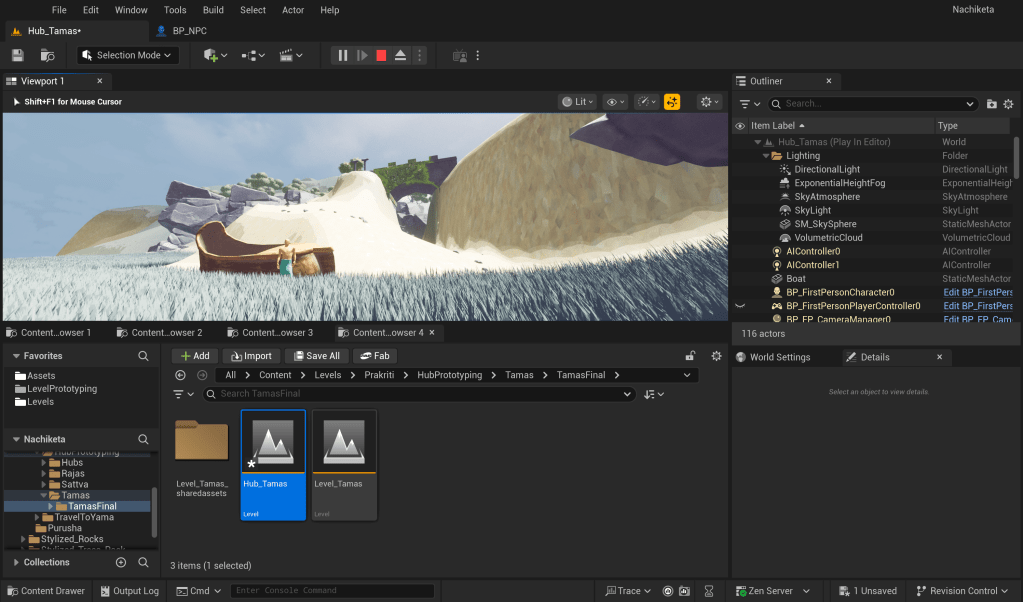
Since this posed a steep learning curve, I also had to make sure that the mechanics of my game were within scope. The walking simulator genre fit in perfectly, because its relatively simpler to develop, making development much easier, and it was also the perfect medium to encapsulate all the complexities of the topic being explored.
This isn’t a review, but once I was past Unreal’s steep learning curve curve, I actually found it much easier to implement game mechanics really quickly. Blueprints is a much more intuitive way to code than manually writing all the code. Since it is visual, and provides much faster ways to debug. I also found that unreal engine cooperates really well with 3D modelling softwares like Maya, and also has a much more intuitive way to work with terrain. Fab is also a great marketplace that I used later to buy some foliage.
3D Modelling Software
For the 3D modelling software, I stuck to something that I am comfortable with, Maya.
Unfortunately, it is the case that with Maya education licence I cannot use my work in commercial purposes, which causes a lot of problems in the long run.
But for now, I didn’t see the need to learn a different 3D software like Blender when I am already on such a steep learning curve with Unreal Engine.
UI UX
I used figma for the UI UX of the game. Although it wasn’t used as often as I did in my previous games since UI and UX was at the least of my priorities during production given the scope of the game. It was really more useful towards the end when I had to (and still have to at the time of writing) work on the play testing feedback.
Libraries
Many online libraries were used to hunt for resources used in the game
YouTube studio music(4 2025) was used in certain sections of the game.
Adobe free sound effects(‘Sound Effects Library – Free Sound Effects | Adobe Audition’ 2025) were used for foley and ambience.
Fab was used for models of trees(‘Stylized Trees Pack’ 2025) and rocks(‘Stylized Rock Modular Kit’ 2025).
ChatGPT and Grok was used for quick searches, and frameworks to implement certain mechanics. Grok especially was used often for Unreal tutorials, and I have found it extremely useful for giving elegantly designed solutions to Coding problems.
Substance Painter(‘3D Painting Software for Texturing – Adobe Substance 3D’ 2025) was used to texture all the objects created through Maya, along with all the default provided textures.
Mixamo(‘Mixamo’ 2025) was used to animate the various characters in the game.
Photo-manipulated Pixar 128 textures (‘Pixar One Twenty Eight’ 2025) were used to paint the textures of the various landscapes.
Coolors(‘Coolors – The Super Fast Color Palettes Generator!’ 2025) was often used for its expansive library of colour palettes
Sound effects from Freesound (‘Freesound’ 2025)were used for the meditation tracks
The Making Phase
Cel Shading
Implementing Cel Shading can be a bit difficult because of the number of resources available on the internet.
My first implementation of cel shading was done using was done using a YouTube tutorial by Matt Aspland (‘(395) How To Create Cel-Shading In Unreal Engine 4/5 (Tutorial) – YouTube’ 2025)
This implementation taught me the basics, like how cel shading was a post processing effect implemented by an infinite extend volume, and how cel shading is implemented using an if statement with a brightness/values input.
Although this is a great tutorial, it was missing a lot of artistic control that I wanted, like colour grading and modifying the number of bands. It also had a hard time rendering anything with any sort of specular reflection, or translucency. Because of this I wanted to explore more options
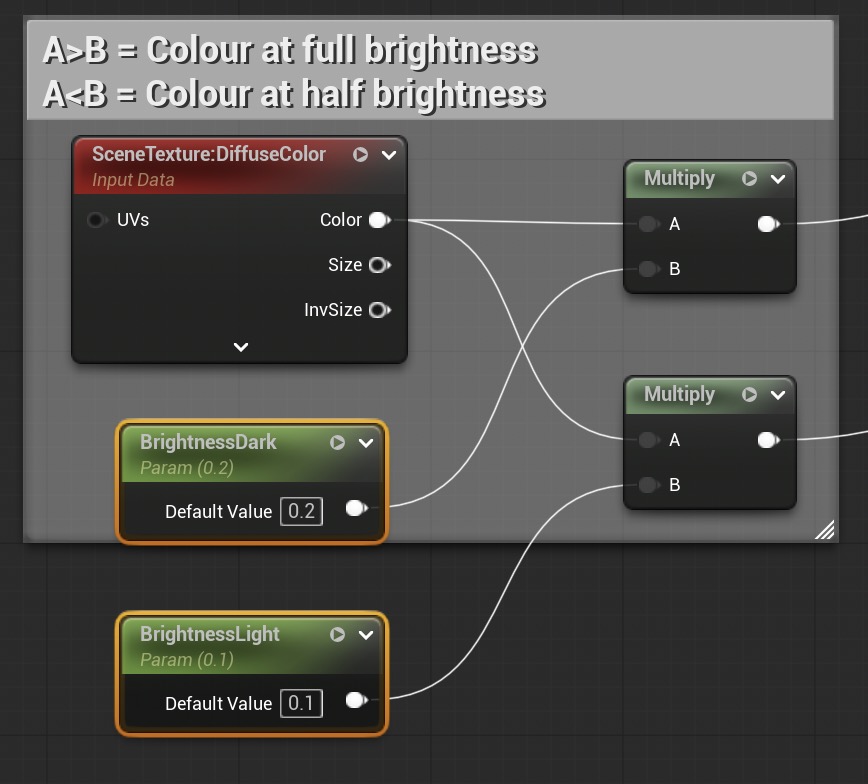

The second tutorial I watched was one from Reality adrift studio(‘(395) UE5 | UE4 Tutorial : Cel – Toon Shader – YouTube’ 2025).
This one has far more control, with the ability to modify colours for ambient occlusion, shadows, ability to change the number of bands etc. It also has a stencil pass to mask for whatever materials might have a harder time to render.

Character Design
Once I was done with figuring out what I wanted, I started modelling it.
Modelling started with a base biped mesh available inside Maya. The mesh was first sculpted, and then retopologised.
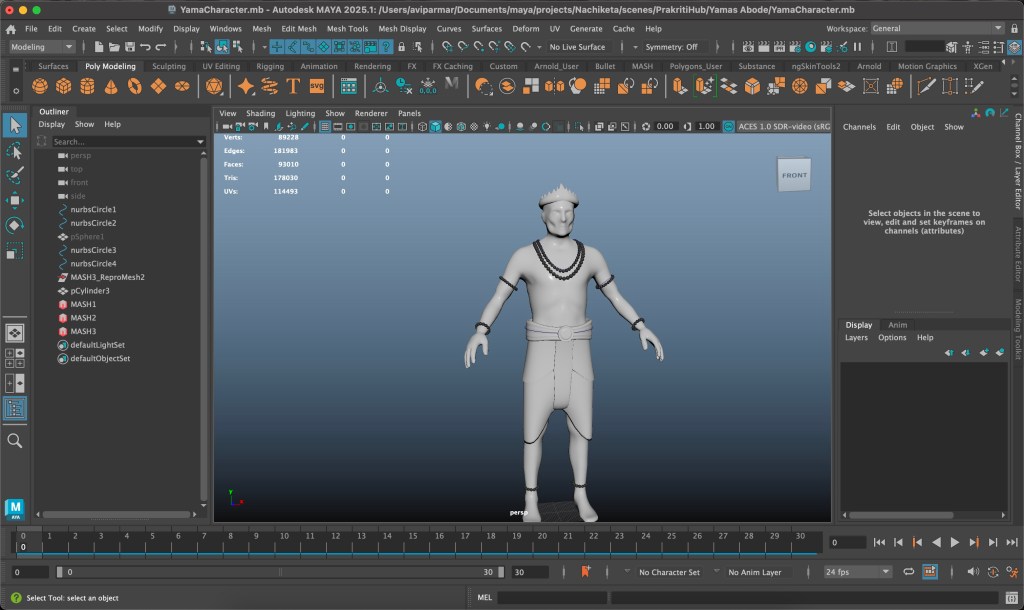
The mesh was then sent through substance painter for texturing.
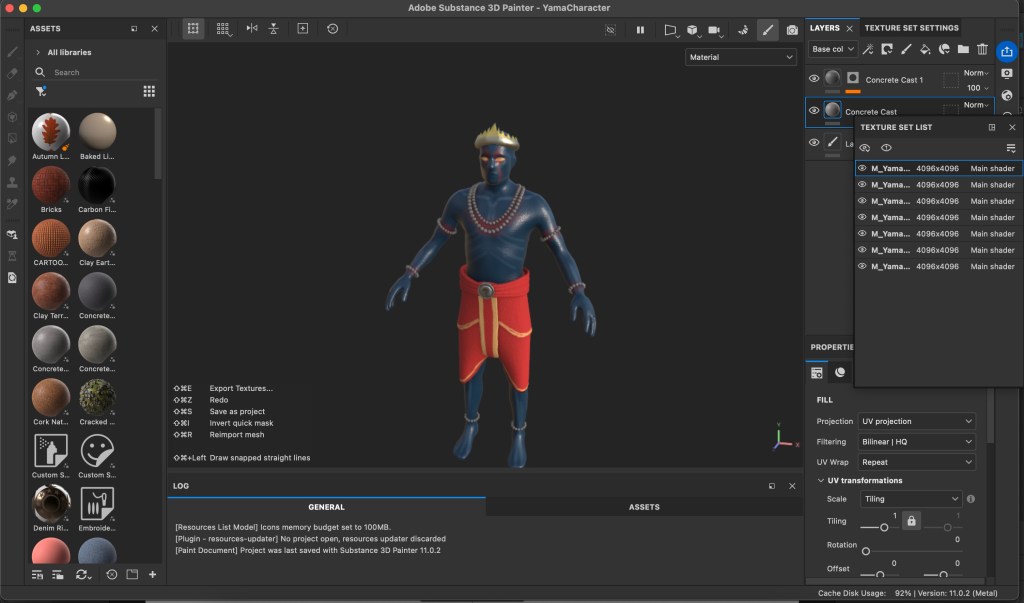
Once the mesh was ready, it was sent through mixamo, to rig and animate.
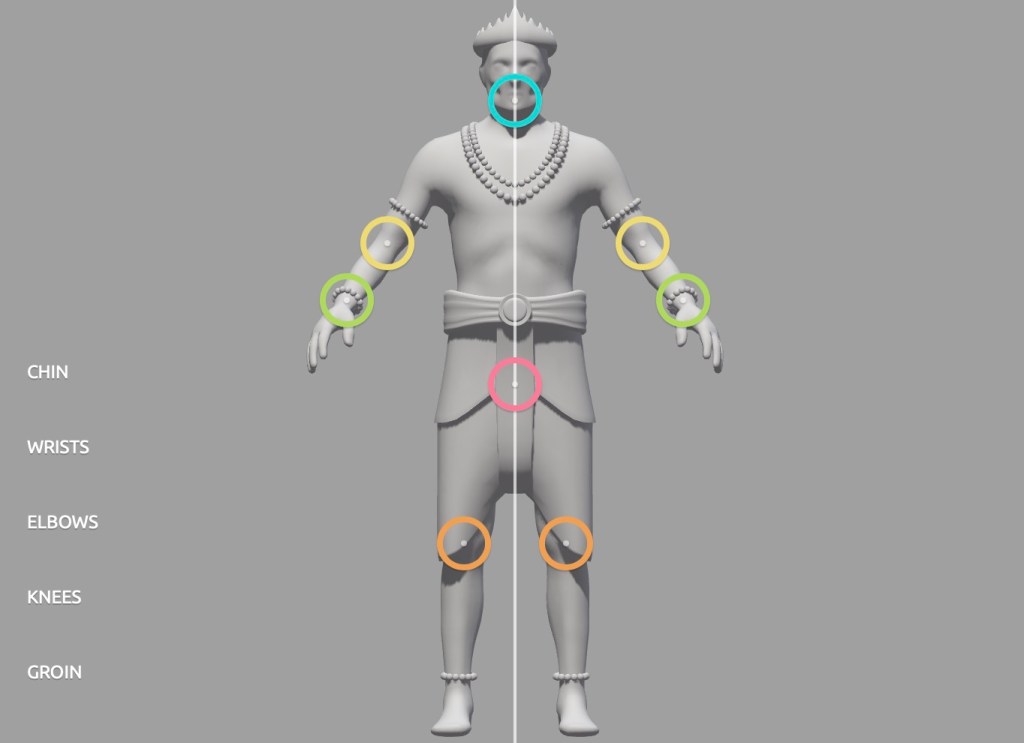
Once all of that was done, the exported model was ready to be sent with its materials and textures to Unreal Engine.
Once the model was rebuilt in Unreal Engine, it would be compiled to a character blueprint, where all the final modifications would take place.
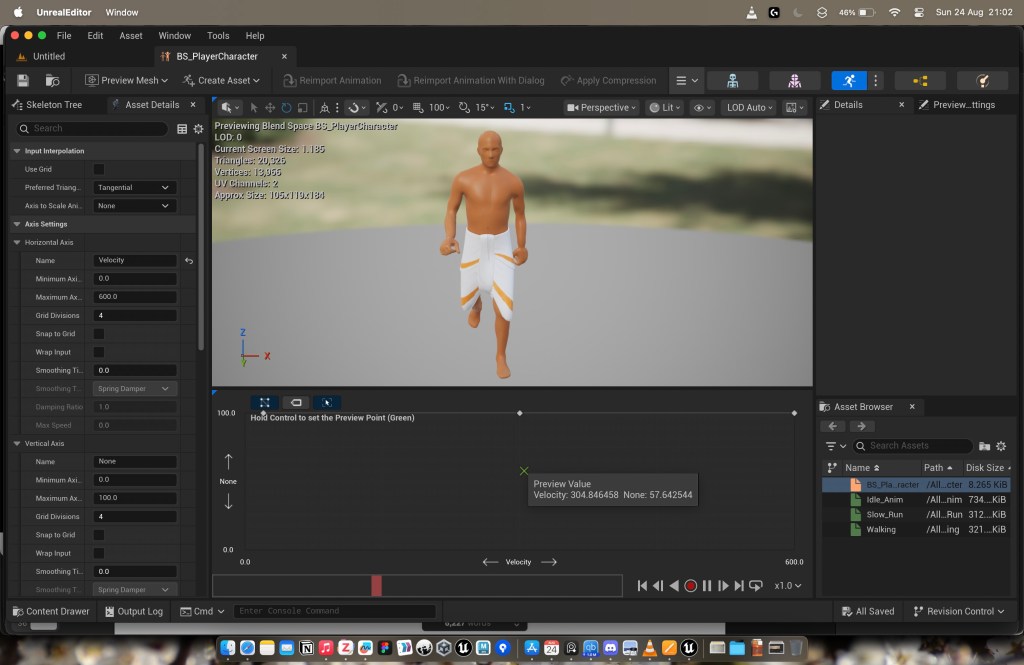
This is where I would add the animation assets, animation blendspaces, sound effect, and any other mechanics necessary.
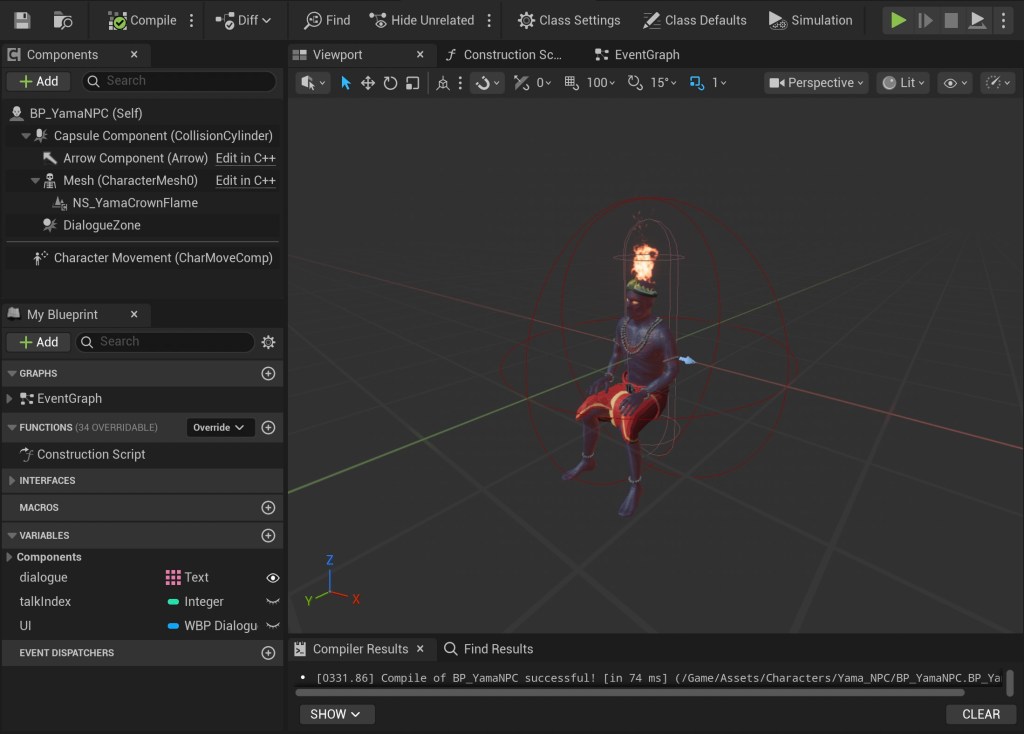
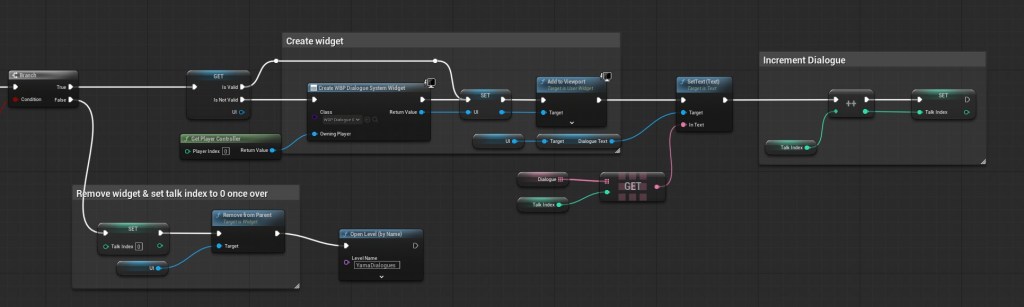
One common mechanic that got replicated through all the NPC characters, was the dialogue mechanic. The dialogue mechanic worked using a ‘dialogue’ text array, an ‘index’ integer, and a ‘UI’ UI widget reference object. Every time the player character pressed the interact button, the index would go up, printing the text from the dialogue array to the UI widget.
For the character model of the player character, I wanted the textures to be more precise, along with more precise animation blending, since the only use of this model would be for when the user looks down.


Environment Design
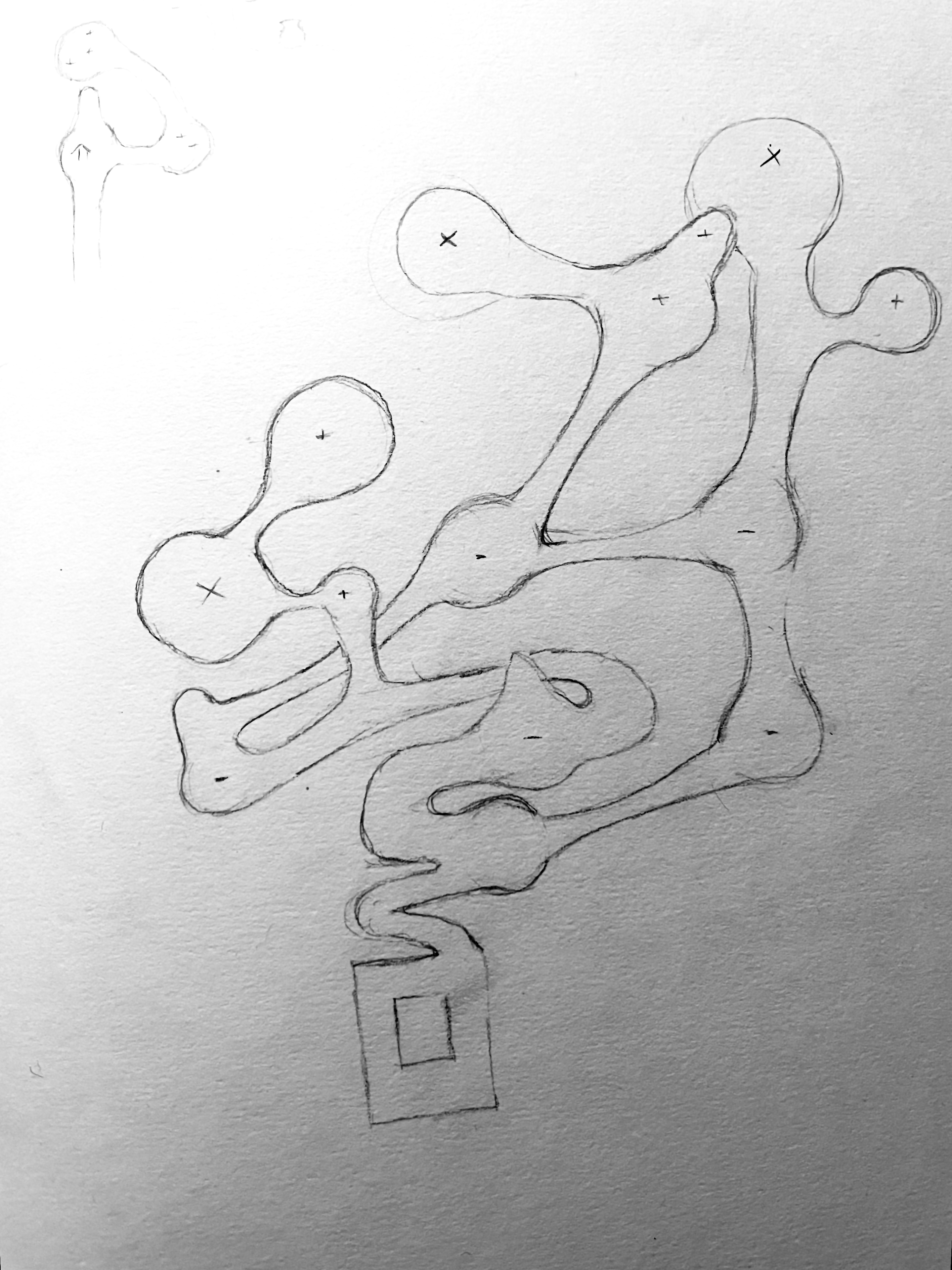
The first step with environment design was to refer to the research that was done previously. Many of the sketches for the level progression were already made, and all that was left was its implementation.

First attempt
My first iteration for creating these maps was using the traditional pipeline, modelling in Maya and exporting to unreal.
This posed a lot of challenges, many of which were partly because of the steep learning curve of Unreal Engine.

The first challenge, was that it was difficult to iterate between transporting the models between the softwares.
The second challenge, was that the collisions did not register as intended in unreal engine, leading to clipping in moving characters, and clipping in foliage on the terrain.
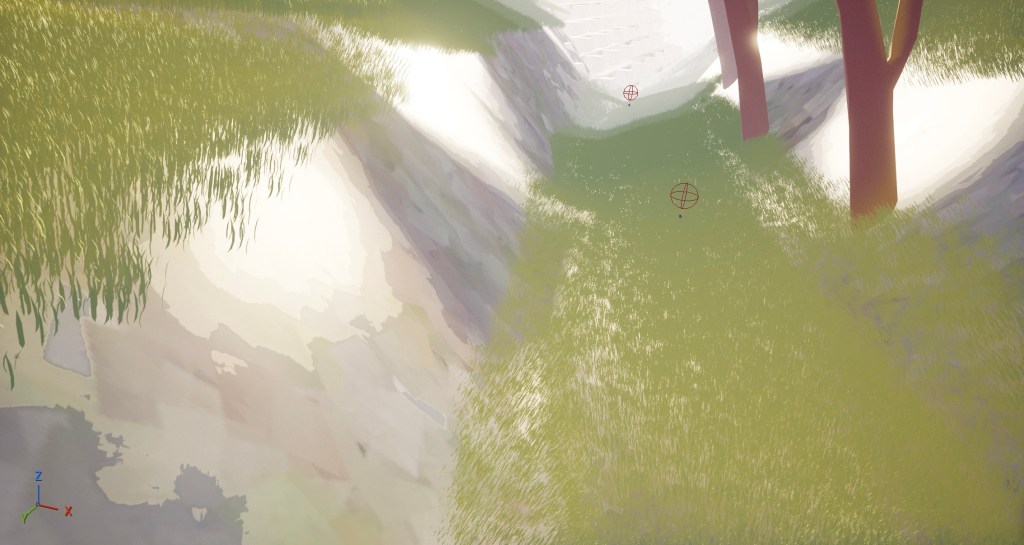
The third challenge, was that there were a lot of unreal engine features, like the water plugin, or the texture painting, that were useful in the long run and only worked in unreal terrain, and it wasn’t worth it to model traditionally and export to unreal.
Second attempt
On my second attempt, I made the whole landscape using Unreal Engine’s built in terrain modelling system, which allowed for much better ease-of-use, and plugins and features.
Painting the textures was done through the built in terrain painting system, and the textures being fed in were from the previously mentioned Pixar 128 library.
The texture was sent through gimp, where it passed through a stylise filter to produce a tiled texture.
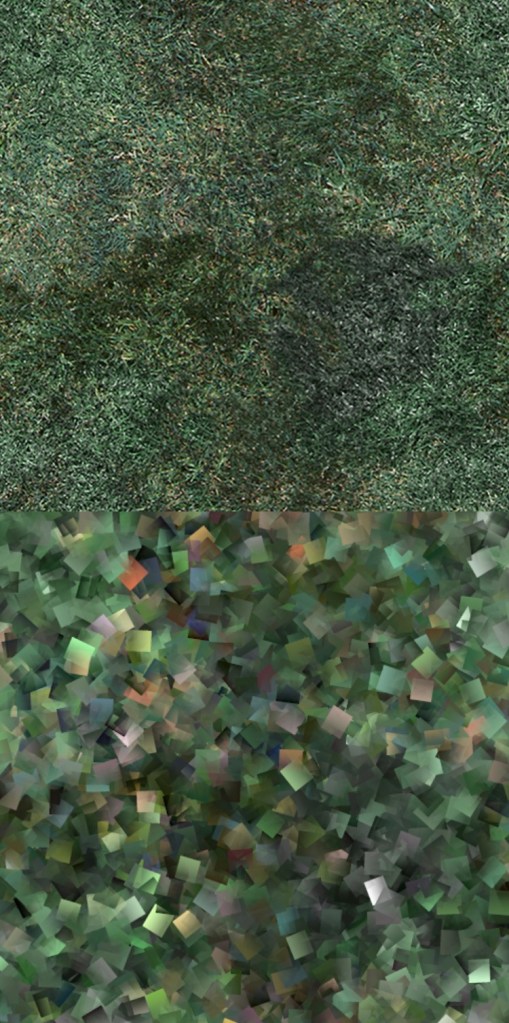
This texture is then desaturated, and multiplied with the appropriate colour in unreal engine, to product the desired look
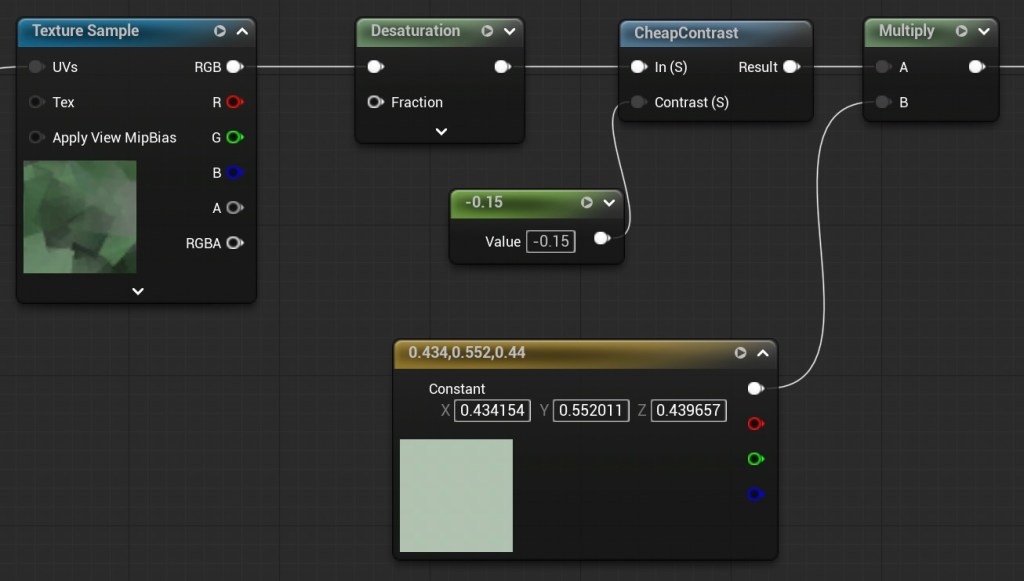
The resulting look is stylised, and allows for more artistic control, while still feeling immersive.

Mechanics Design
There were a lot of different mechanics that went into the game, but for the purposes of this documentation, I aim to give an overall view while covering mechanics that I found important to elucidate upon.
Exposition Level
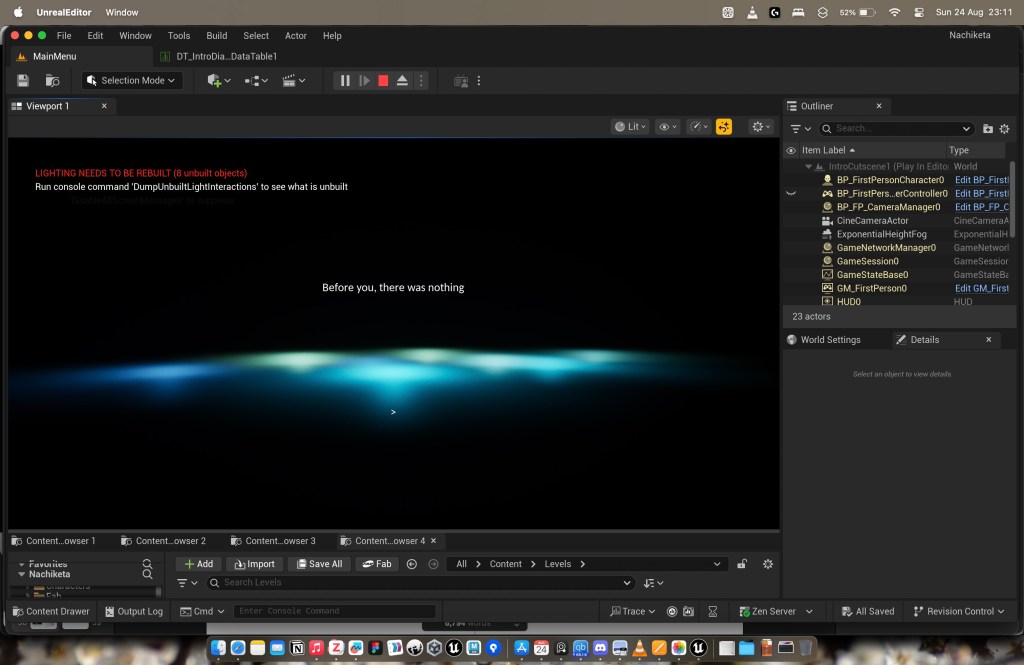
The exposition of the game was heavily inspired by Firewatch. I aimed to have a super simple dialogue system with a focus on ambience and background, with bits of gameplay in the middle.

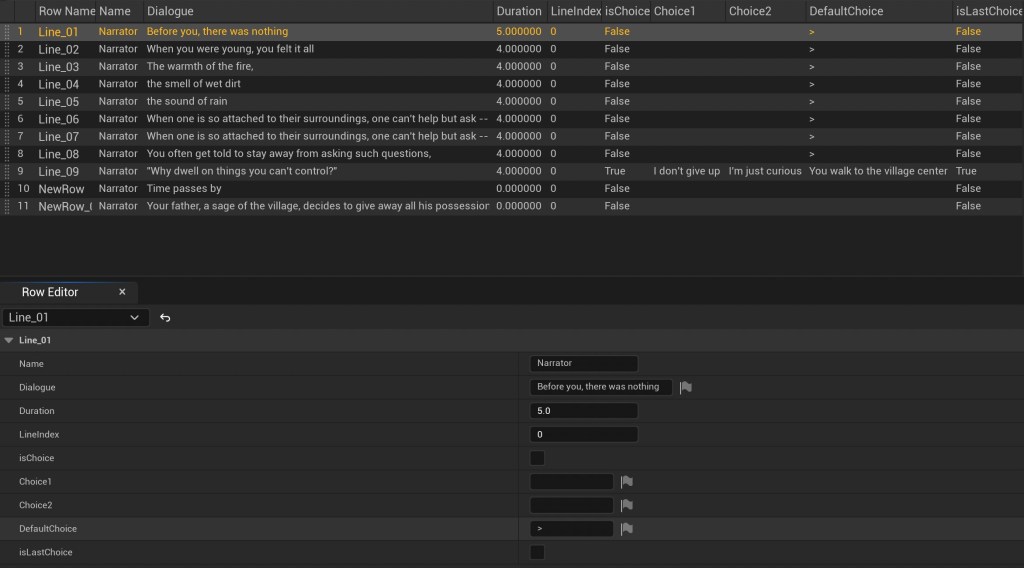
The dialogue system was powered by a data table in unreal engine, so I could change the dialogues later on in development if I felt there was something wrong.
Meditation mechanics
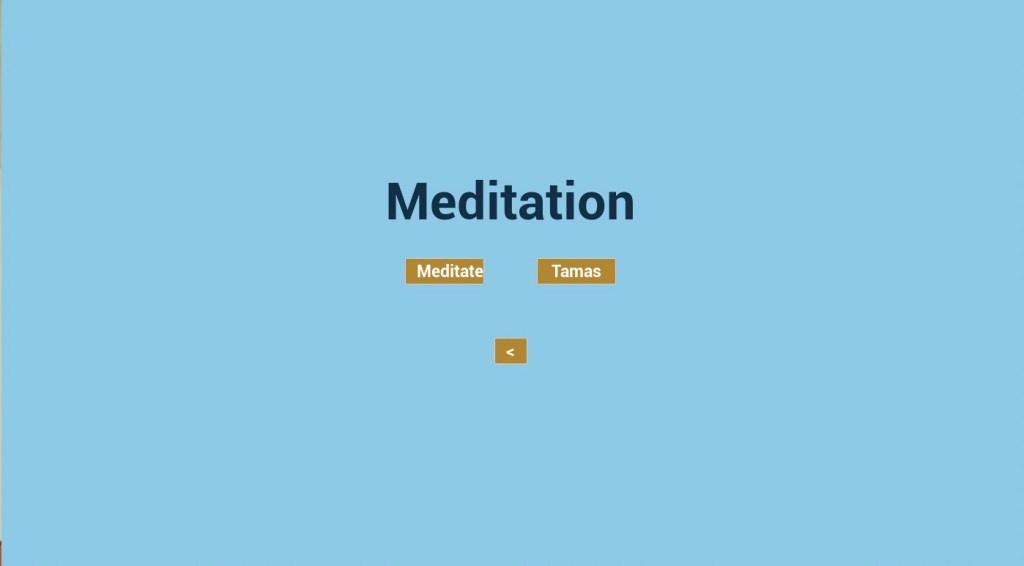
The meditation mechanics of the game were made using widget blueprints and sound effects I found from free sound.
The meditation tracks were carefully designed, with just a VoiceOver(‘Meditation – Free Pack’ 2025), music(‘Freesound – Piano for Meditation by SergeQuadrado’ 2025) and a timer(‘Freesound – Ten Minute Meditation Timer by Stomachache’ 2025).
Meditation tracks were meant to mimic the meditation loop(‘(118) Designing a Trance: Meditation and Game Design – YouTube’ 2025), with level progression meditation tracks informing the user a little about what the characteristic of nature(tamas, rajas or sattva) is about, and how it can play a role in meditation.

Tamas Mechanics
During production, a lot of the mechanics from the initial design were cut down, due to scope, and because for the purposes of a prototype, not everything needs to be implemented to get a feel across.
Tamas was also one of the first levels I worked on in Unreal Engine. Because of this, I made a lot of mistakes, and I kept coming back to fix this level.
The basic objective of the Tamas level became to collect the perfect number of orbs, to activate a beacon that adds stamina to the player character.
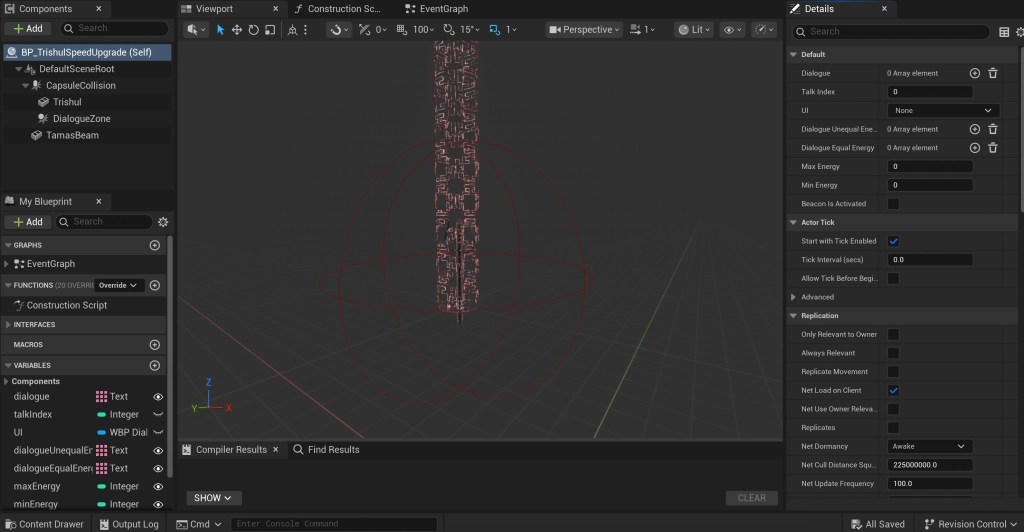
After the character activates three beacons, the user can sprint back over to the gate and go to the next hub.

Rajas mechanics
Rajas had similar mechanics as tamas, in the sense that beacons would have to be activated for the player to move to the next level.
But since Rajas is meant to signify energy and movement, the level was designed in a much more linear fashion, where the play has to climb higher and higher until they reach the highest beacon.
This feeling of climbing height, is mixed with the frustration of being able to fall all the way down, and the frustration of solving puzzles.
The puzzles were developed based on a game called kami(‘KAMI’ 2025), where the objective is to match all the boxes’ colours using a limited number of chances.
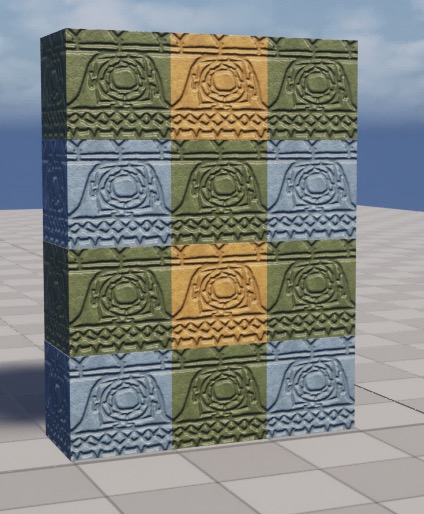
This was a good exercise for me to further my skills in unreal blueprints. Between exception errors, boolean errors and assigning material errors, this took a lot of time, but I finally ended up with something that was fairly usable for the game.
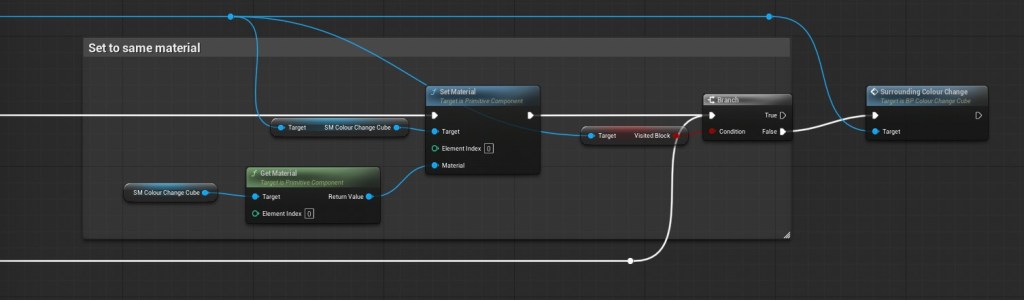
The number of chances would be dictated by the points the player has collected.

Sattva mechanics
levels, this one was the easiest to implement. Satvva was meant to be a deep game level design, where the player must stop if they want to progress to the next level.

Once the player stops, the exposure begins to increase. Once the exposure makes the whole screen white, the level changes.
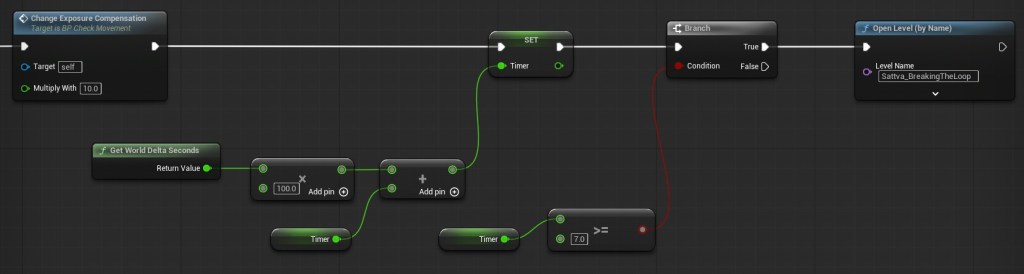
In the next level, the cel shader effect ends, signifying a liberation from nature.
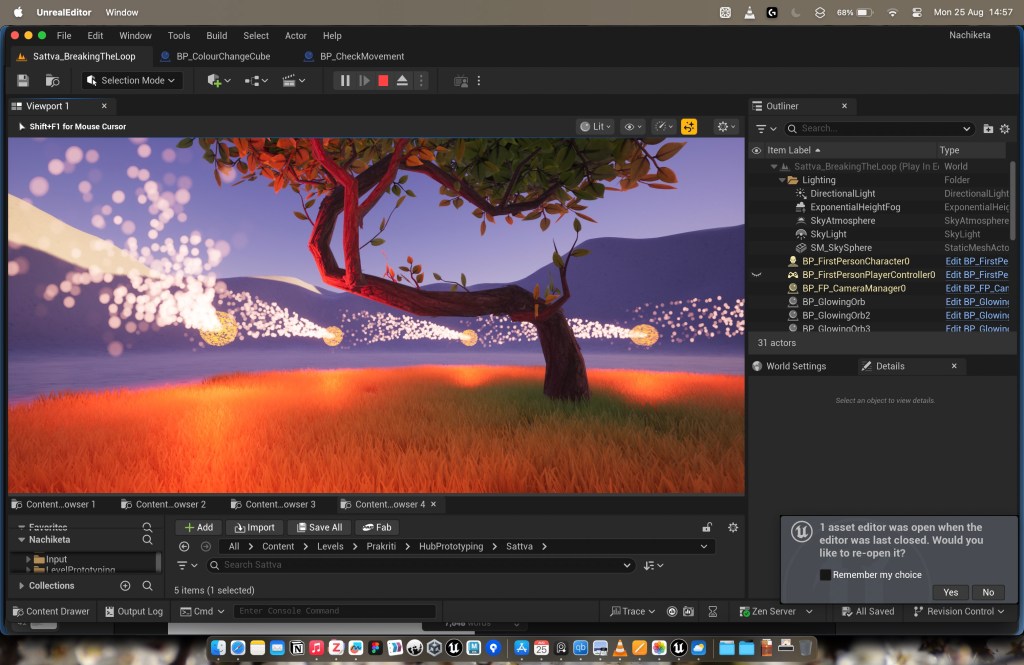
The user has to meditate one last time, before they are put back into the ship that goes to Yama’s abode.
Primordial matter mechanics
In this part of the game, the player plays as an orb, which symbolises the soul.
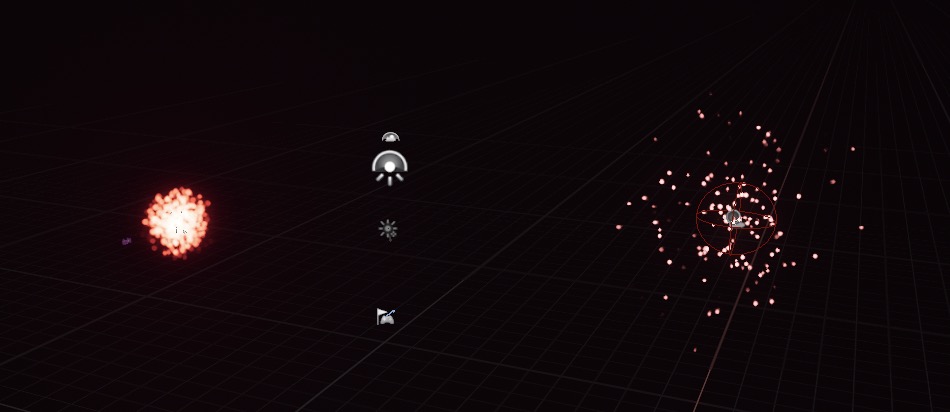
The soul is put in an empty world, with nowhere to go. In the distance is an abstract form.
When the player character is in proximity with this form, it opens a level with a clock, and a man walking, with the sun going up and down. The player has to move their mouse for the man to continue walking, and a puzzle to appear.
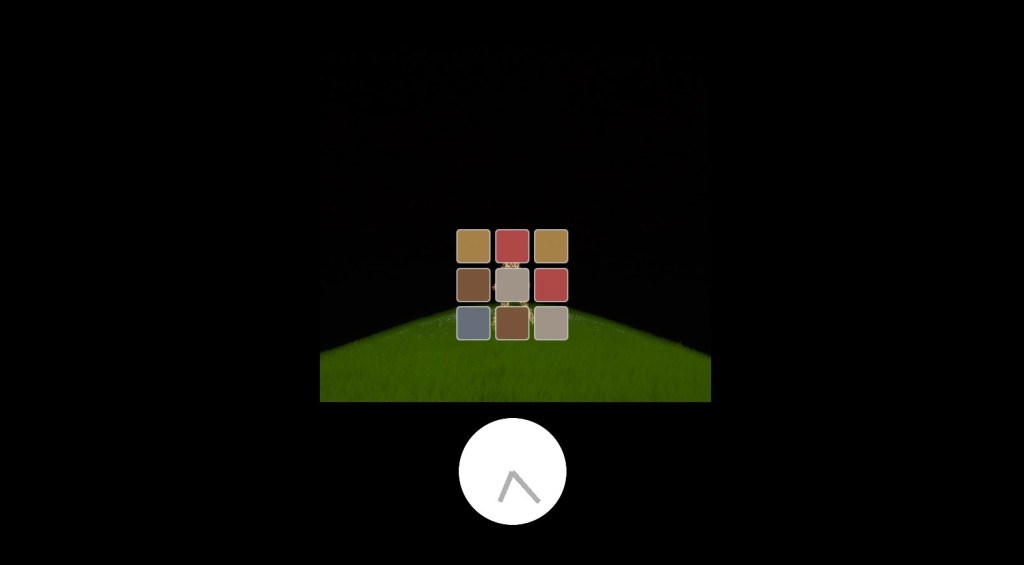
This puzzle was inspired by Florence, where the player has to simply click on the two boxes of matching colours to progress.
This little mini game is meant to symbolise prakriti (nature), and the entire task itself is meant to signify the samkhya saying of how the universe begins when primordial matter comes into proximity with prakriti.
Temple Models
The temples were modelled on Maya using poly modelling techniques without any organic modelling techniques (like sculpting).
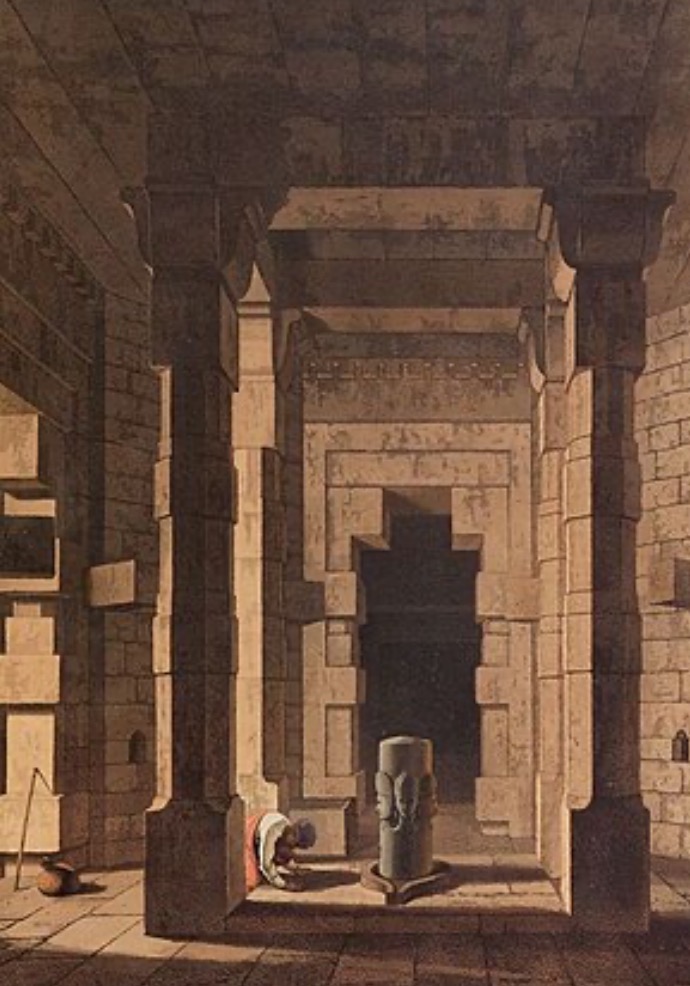

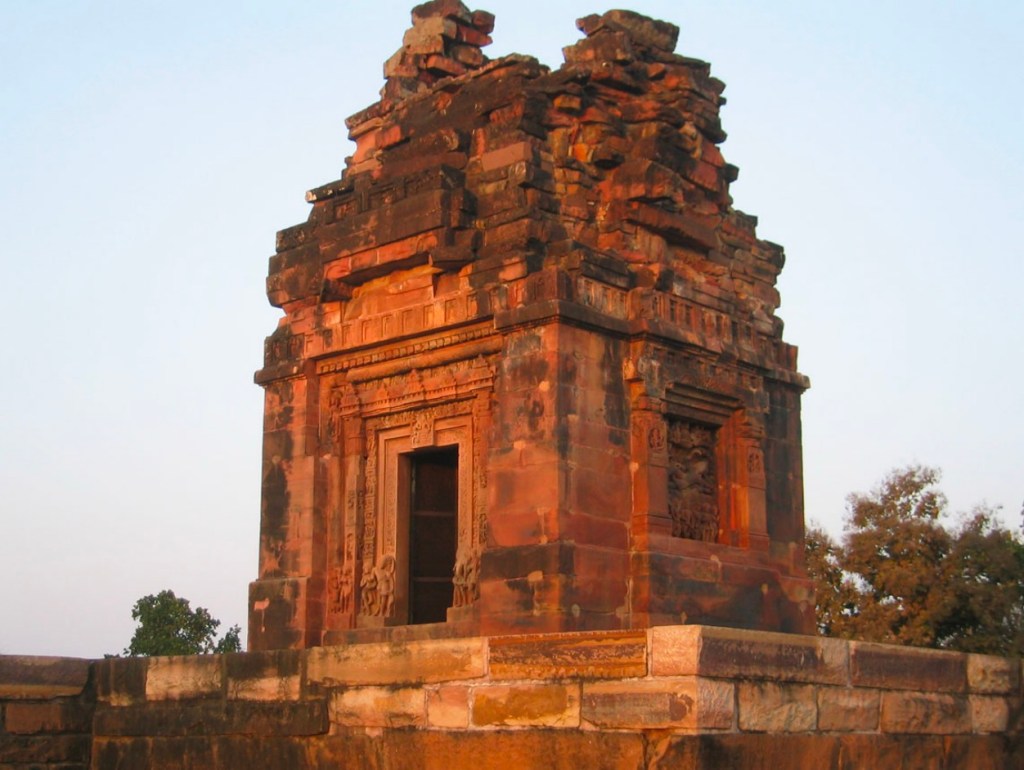
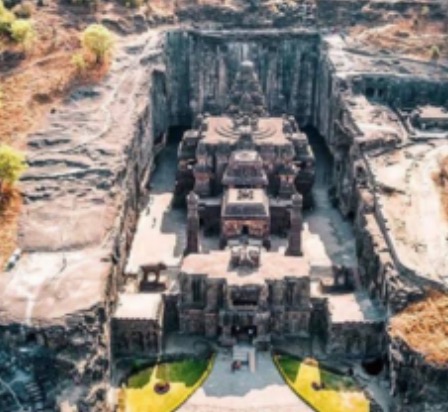
Inspiration for these models were taken from ancient temples in India, like Mundeshwari(‘Oriental Scenery Part 5 Fig 13 – Mundeshwari Temple – Wikipedia’ 2025), Dashavatar(‘Dashavatara Temple, Deogarh’ 2025) and Kailasa (‘Kailasa Temple, Ellora’ 2025)
These models were textured in Substance painter, and then imported into Unreal Engine, where collisions, and auto-LODs were applied to all the models.
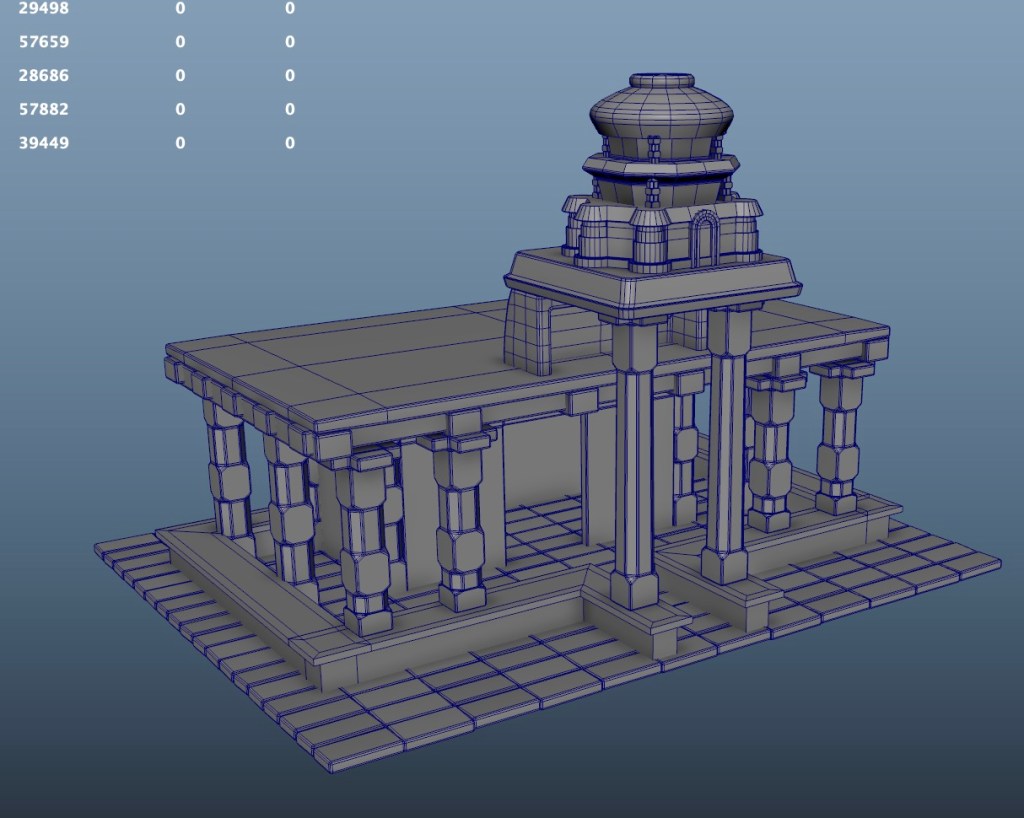
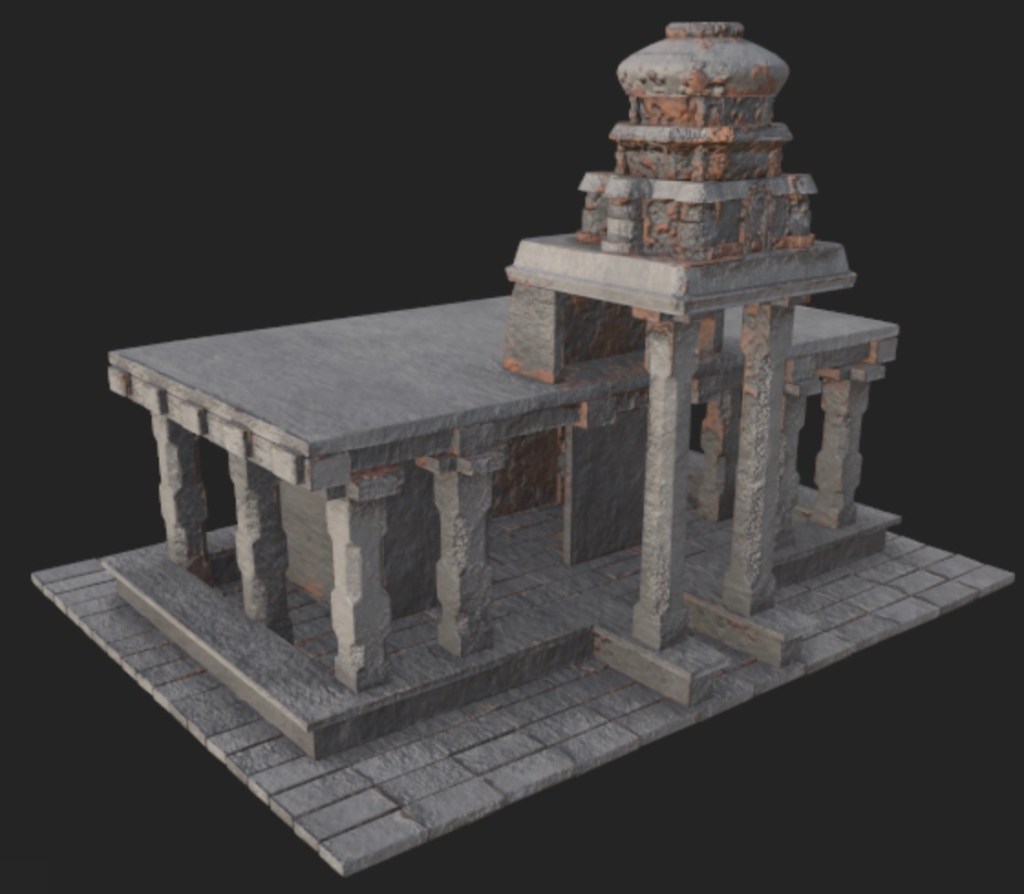
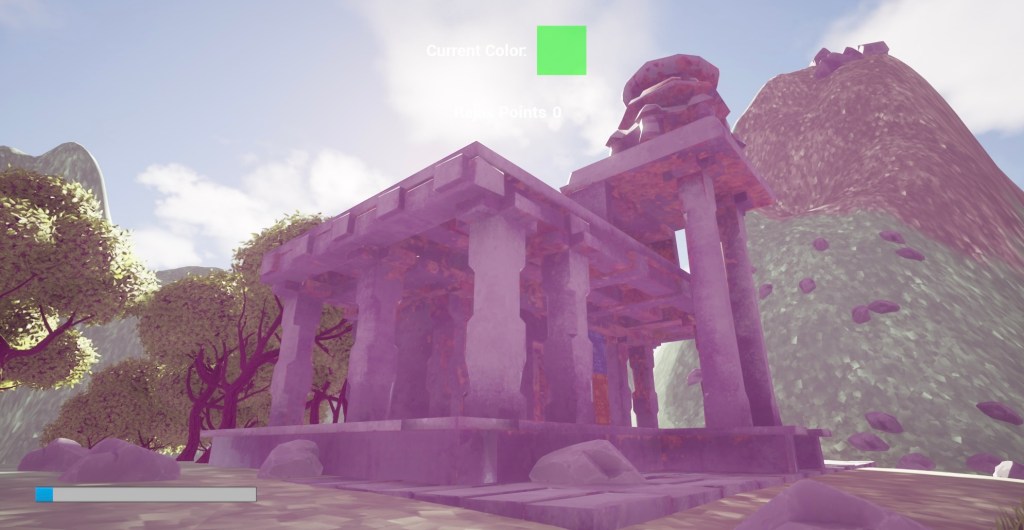
Here are some other temples through the game:
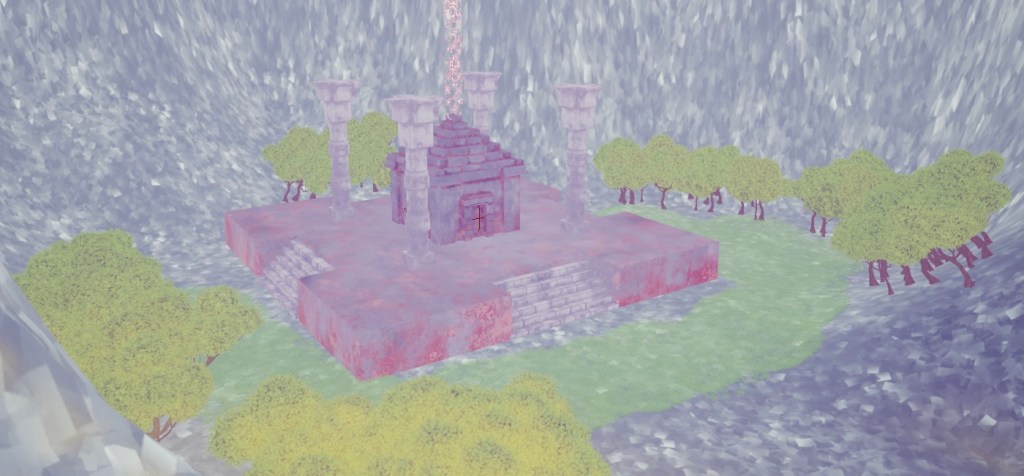
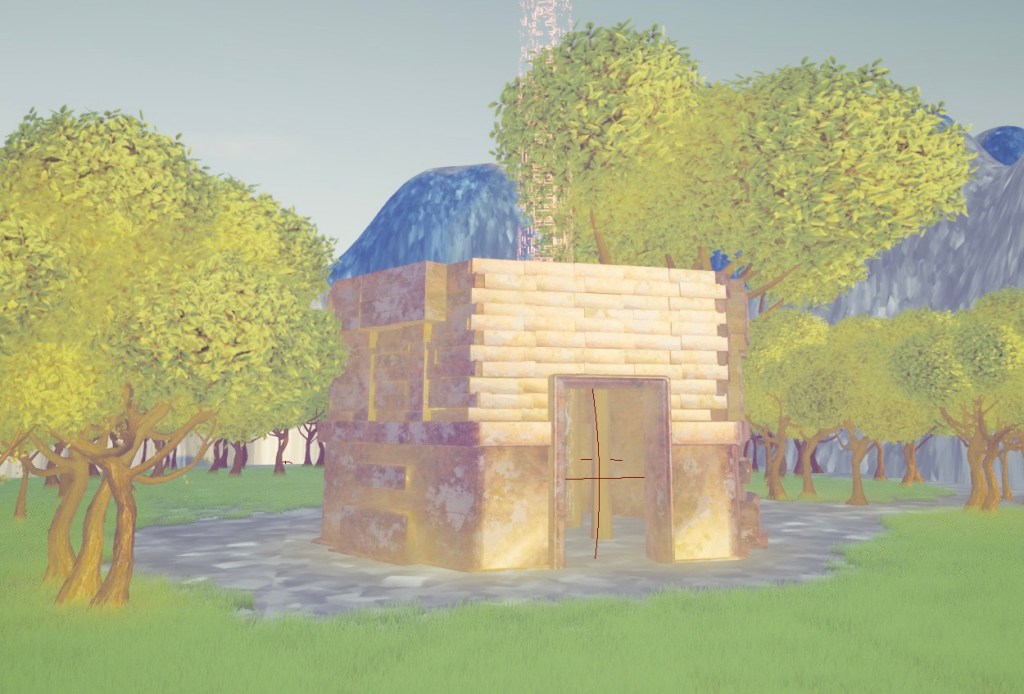
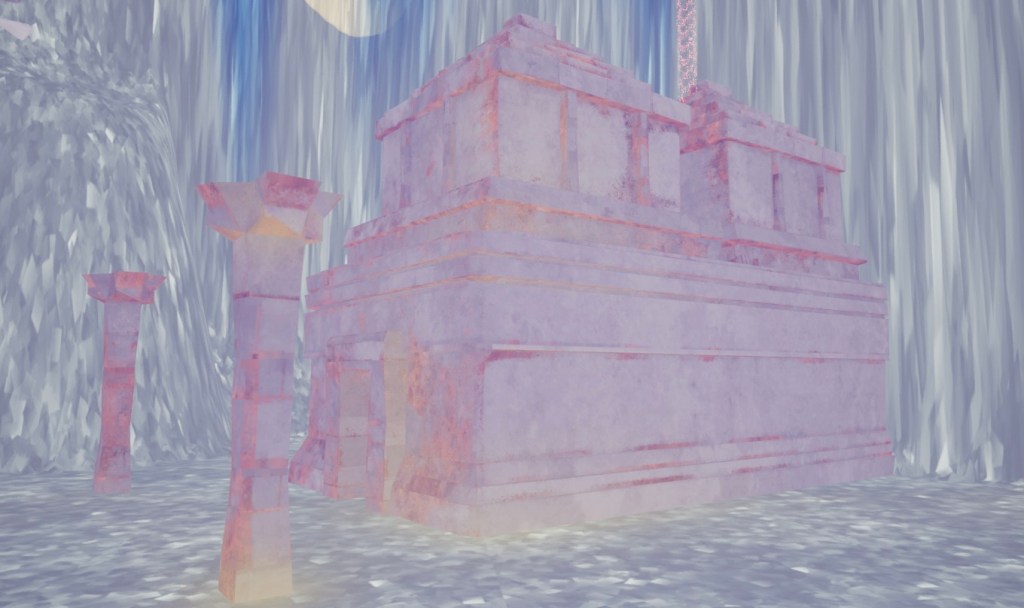

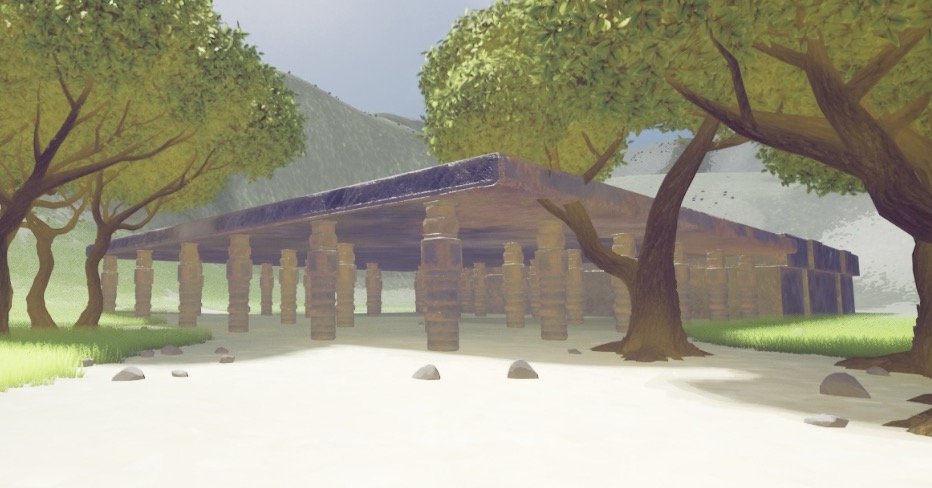
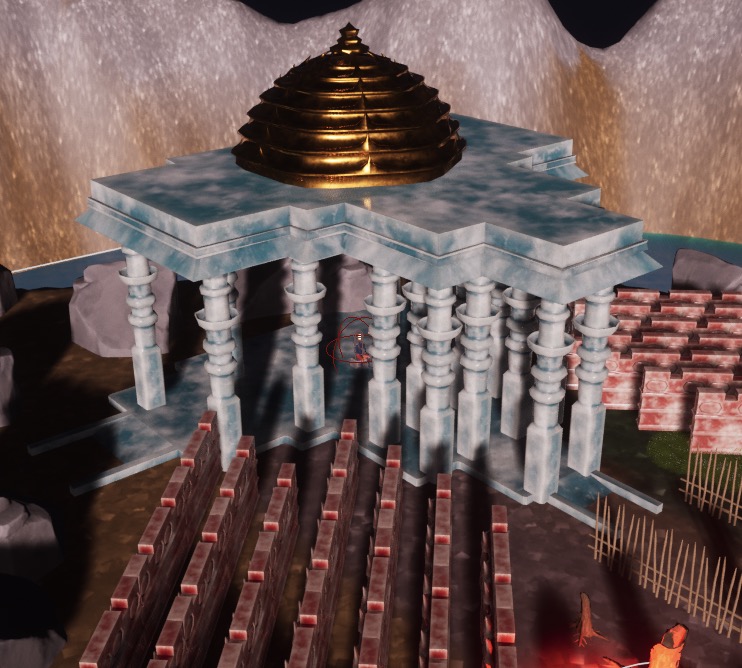
These models help to sell the feel of playing a game that is set in an Indian context.
There were other models throughout the game as well, like fences, houses and architecture. All of them have used the same process.
If theres anything I feel is missing, its probably lighting. Torches, chandeliers and other lamps could add a lot more dynamic lighting to the scenes.
Sound Design
For the sound design, I first tried to experiment with ragas, which in my mind sells the feel of being in this setting.
I began by emailing to a YouTube channel asking them for usage rights, since I felt that music(‘(397) Rāga Kambhoji– A Flute’s Sacred Flow by K. Kamalavaasan – YouTube’ 2025) fit in perfectly with that game.
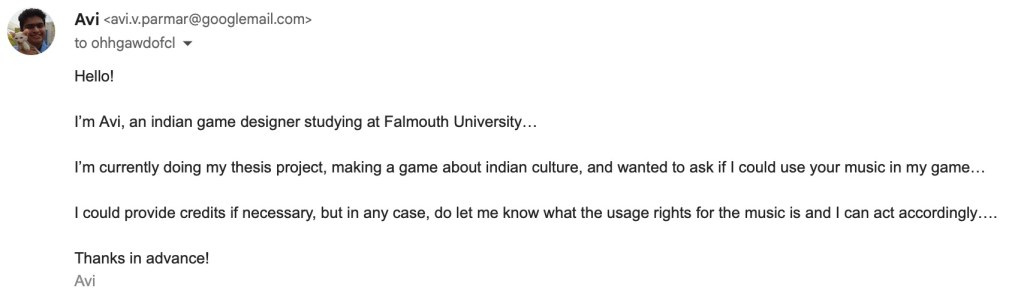
Unfortunately, after a short lived convo, I couldn’t get more replies, so I stayed away from his music.
I ended up using music from YouTube studio, since that was the closest I could get to free music, and use Indian music without diving through the depths of the internet.
I don’t really like the feel of the music, and at the time of writing this, the next thing on my plan is to change the music of the game.
For ambience and foley, I used adobe sounds. Ambience of wind through leaves plays through a lot of levels. Sometimes ambience of people and noise is used to sell a feel that couldn’t be accomplished due to the scope of the project not supporting for more 3D models.
Sounds like the Om sound used in the primordial material, are contested in research. Om is the sound that made the universe, and in the love, the player is creating the universe by getting nature and primordial material in proximity.
I was inspired by Bioshock with the sound effects on the main menu screen. When the user hovers their mouse on the main menu button, it plays a random note from the D major scale, of an instrument that sounds like a sitar. This makes it so that the user feels like they are creating music by simply hovering their mouse over the buttons.
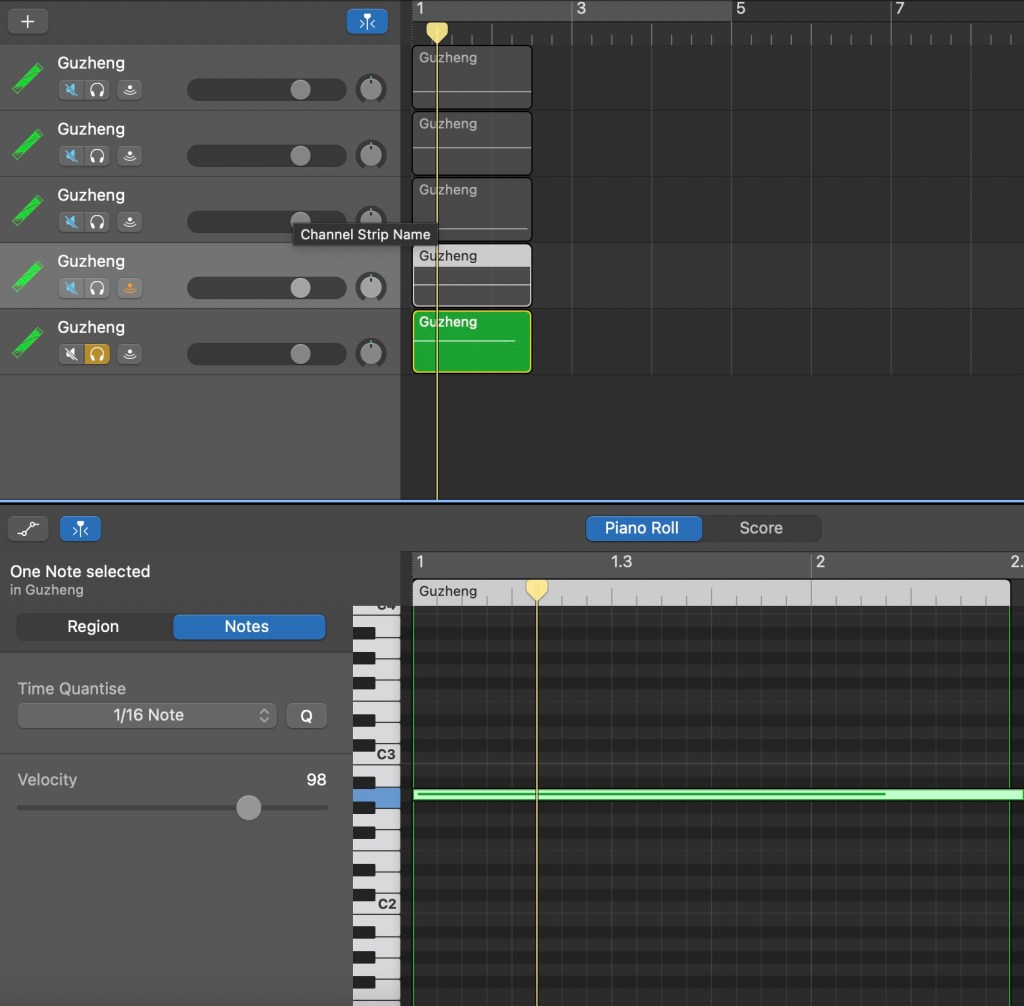
Many other notification sounds were created in GarageBand with notes from an instrument.
Bibliography
‘3D Painting Software for Texturing – Adobe Substance 3D’. 2025. [online]. Available at: https://www.adobe.com/uk/products/substance3d/apps/painter.html [accessed 24 Aug 2025].
4, 898 Views 1 Year Ago. 2025. ‘Sandeep Das’. YouTube [online]. Available at: https://www.youtube.com/channel/UCnbtxwILTDgqPQMhBSdQXJQ [accessed 24 Aug 2025].
112 Upanishads ( Sanskrit Text, English Translation, An Exhaustive Introduction Index Of Verses) 2 Volume Set. n.d. Available at: http://archive.org/details/112-upanishads-sanskrit-text-english-translation-an-exhaustive-introduction-inde [accessed 23 Aug 2025].
‘(118) Designing a Trance: Meditation and Game Design – YouTube’. 2025. [online]. Available at: https://www.youtube.com/watch?v=zZ8BFsdbem0 [accessed 17 Feb 2025].
‘(212) What Does Surapadma and His Brothers Represent? – YouTube’. 2024. [online]. Available at: https://www.youtube.com/ [accessed 7 Dec 2024].
‘(391) History of Yoga Full Film English – YouTube’. 2025. [online]. Available at: https://www.youtube.com/ [accessed 22 Aug 2025].
‘(391) OM CHANTING 10 Minutes | 432Hz Om Mantra to Raise Positive Energy Vibrations – YouTube’. 2025. [online]. Available at: https://www.youtube.com/ [accessed 22 Aug 2025].
‘(395) How To Create Cel-Shading In Unreal Engine 4/5 (Tutorial) – YouTube’. 2025. [online]. Available at: https://www.youtube.com/ [accessed 24 Aug 2025].
‘(395) UE5 | UE4 Tutorial : Cel – Toon Shader – YouTube’. 2025. [online]. Available at: https://www.youtube.com/[accessed 24 Aug 2025].
‘(397) Rāga Kambhoji– A Flute’s Sacred Flow by K. Kamalavaasan – YouTube’. 2025. [online]. Available at: https://www.youtube.com/ [accessed 25 Aug 2025].
‘A Rasa Reader | Columbia University Press’. 2025. [online]. Available at: https://cup.columbia.edu/book/a-rasa-reader/9780231173919/ [accessed 17 June 2025].
‘Coolors – The Super Fast Color Palettes Generator!’ 2025. Coolors.co [online]. Available at: https://coolors.co/ [accessed 24 Aug 2025].
‘Dashavatara Temple, Deogarh’. 2025. Wikipedia. Available at: https://en.wikipedia.org/w/index.php?title=Dashavatara_Temple,_Deogarh&oldid=1297661564 [accessed 23 Aug 2025].
DEHEJIA, Vidya. 1990. ‘On Modes of Visual Narration in Early Buddhist Art’. The Art Bulletin 72(3), 374–92.
‘File:Deogarh01.Jpg – Wikipedia’. 2005. [online]. Available at: https://commons.wikimedia.org/wiki/File:Deogarh01.jpg[accessed 23 Aug 2025].
‘Firewatch: Out Now for Windows, Nintendo Switch, PlayStation 4, Mac, and Linux’. 2025. Firewatch [online]. Available at: http://www.firewatchgame.com/ [accessed 23 Aug 2025].
‘FLORENCE – ANNAPURNA INTERACTIVE’. 2025. Annapurna [online]. Available at: https://www.annapurna.com/interactive/florence [accessed 28 Aug 2025].
‘Freesound’. 2025. [online]. Available at: https://freesound.org/ [accessed 24 Aug 2025].
‘Freesound – Piano for Meditation by SergeQuadrado’. 2025. [online]. Available at: https://freesound.org/people/SergeQuadrado/sounds/740607/ [accessed 5 Mar 2025].
‘Freesound – Ten Minute Meditation Timer by Stomachache’. 2025. [online]. Available at: https://freesound.org/people/stomachache/sounds/474623/ [accessed 5 Mar 2025].
KAGAN, Noah. 2024. Million Dollar Weekend. Available at: https://www.penguin.co.uk/books/448467/million-dollar-weekend-by-kagan-noah/9781529146189 [accessed 23 Aug 2025].
‘Kailasa Temple, Ellora’. 2025. Wikipedia. Available at: https://en.wikipedia.org/w/index.php?title=Kailasa_Temple,_Ellora&oldid=1304202494 [accessed 25 Aug 2025].
‘KAMI’. 2025. State of Play [online]. Available at: https://www.stateofplaygames.com/kami [accessed 25 Aug 2025].
LANKOSKI, Petri. 2024. Game Design Research: An Introduction to Theory & Practice. Carnegie Mellon University. Available at: https://kilthub.cmu.edu/articles/journal_contribution/Game_Design_Research_An_Introduction_to_Theory_Practice/6686750/1[accessed 22 Aug 2025].
LUKOFF, Kai et al. 2020. ‘From Ancient Contemplative Practice to the App Store: Designing a Digital Container for Mindfulness’. In Proceedings of the 2020 ACM Designing Interactive Systems Conference. 1551–64. Available at: http://arxiv.org/abs/2006.09521 [accessed 4 Feb 2025].
‘Meditation – Free Pack’. 2025. SampleMe | Unique Female Vocal Samples [online]. Available at: https://sampleme.sellfy.store/p/meditation-free-pack/ [accessed 5 Mar 2025].
‘Mixamo’. 2025. [online]. Available at: https://www.mixamo.com/#/ [accessed 24 Aug 2025].
‘Mundeshwari Temple’. 2025. Wikipedia. Available at: https://en.wikipedia.org/w/index.php?title=Mundeshwari_Temple&oldid=1300985846 [accessed 23 Aug 2025].
‘Oriental Scenery Part 5 Fig 13 – Mundeshwari Temple – Wikipedia’. 2025. [online]. Available at: https://en.wikipedia.org/wiki/Mundeshwari_Temple#/media/File:Oriental_Scenery_Part_5_Fig_13.jpg [accessed 25 Aug 2025].
Pather Panchali [Film]. 1955. Government of West Bengal.
‘(PDF) A STUDENT’S HANDBOOK OF INDIAN AESTHETICS NEERJA A CONTENTS’. 2025. ResearchGate[online]. Available at: https://www.researchgate.net/publication/357866846_A_STUDENT’S_HANDBOOK_OF_INDIAN_AESTHETICS_NEERJA_A_CONTENTS[accessed 17 June 2025].
‘PHILIPPE CHARLES JACQUET’. 2025. M Fine Arts Galerie [online]. Available at: https://www.mfinearts.com/philppe-charles-jacquet [accessed 23 Aug 2025].
‘Pixar One Twenty Eight’. 2025. [online]. Available at: https://renderman.pixar.com/pixar-one-twenty-eight [accessed 24 Aug 2025].
Samkhya #1 [Film]. 2025. Available at: https://www.youtube.com/watch?v=1YNd49zKGr8 [accessed 25 Aug 2025].
‘Samkhya by Avi Parmar’. 2025. itch.io [online]. Available at: https://aviparmar.itch.io/samkhya [accessed 26 Aug 2025].
SCHELL, Jesse. 2008. The Art of Game Design.
‘Screenwriting & Storytelling Blueprint: Hero’s Two Journeys’. 2025. Udemy [online]. Available at: https://www.udemy.com/course/screenwriting-story-blueprint-the-heros-two-journeys-filmmaking/ [accessed 23 Aug 2025].
‘Sound Effects Library – Free Sound Effects | Adobe Audition’. 2025. [online]. Available at: https://www.adobe.com/products/audition/free-sound-effects.html [accessed 24 Aug 2025].
‘Stylized Rock Modular Kit’. 2025. Fab.com [online]. Available at: https://www.fab.com/listings/1aca9571-d2c6-4a22-a8e2-f154545a425f [accessed 23 Aug 2025].
‘Stylized Trees Pack’. 2025. Fab.com [online]. Available at: https://www.fab.com/listings/7ca321e2-f590-4fb8-8435-215f53216322 [accessed 23 Aug 2025].
‘Super Mario OdysseyTM for the Nintendo SwitchTM Home Gaming System – Official Game Site’. 2025. Super Mario OdysseyTM for the Nintendo SwitchTM home gaming system – Official Game Site [online]. Available at: https://supermario.nintendo.com/ [accessed 23 Aug 2025].
‘Tacoma on Steam’. 2025. [online]. Available at: https://store.steampowered.com/app/343860/Tacoma/ [accessed 23 Aug 2025].
‘The Encyclopedia of Indian Philosophies, Volume 4: Samkhya, A Dualist … – Gerald James Larson, Ram Shankar Bhattacharya – Google Books’. 2025. [online]. Available at: https://books.google.co.in/books?hl=en&lr=&id=bqr_AwAAQBAJ&oi=fnd&pg=PP1&dq=philosophy+of+samkhya&ots=85Dpyreu1D&sig=dLe-85tC1EK3Huxv_Q7nsh_pzKc&redir_esc=y#v=onepage&q=philosophy%20of%20samkhya&f=false [accessed 17 June 2025].
‘The First Tree – A Beautiful 3rd-Person Exploration Game’. n.d. [online]. Available at: https://www.thefirsttree.com/[accessed 23 Aug 2025].
TOTTEN, Christopher W. 2019. Architectural Approach to Level Design: Second Edition. 2nd edn. New York: A K Peters/CRC Press.
YAJNADEVAM. 2024. A Cryptanalytic Decipherment of the Indus Script. Available at: http://archive.org/details/a-cryptanalytic-decipherment-of-the-indus-script [accessed 23 Aug 2025].
 Avi
Avi 


Leave a comment